
Locals get mayoral commendation, cut the ribbon on City Hall café
At the ribbon-cutting for Café Melange, Mayor Daniel Lurie acknowledged the work of local entrepreneurs.
At the ribbon-cutting for Café Melange, Mayor Daniel Lurie acknowledged the work of local entrepreneurs.

The neighborhood’s bad reputation made Niko embarrassed to admit it was home. His grandma and others helped change his mind.

At the unveiling of “Stephen Tennis Way,” friends reminisced about the local hero who touched many lives.

The neighborhood’s bad reputation made Niko embarrassed to admit it was home. His grandma and others helped change his mind.

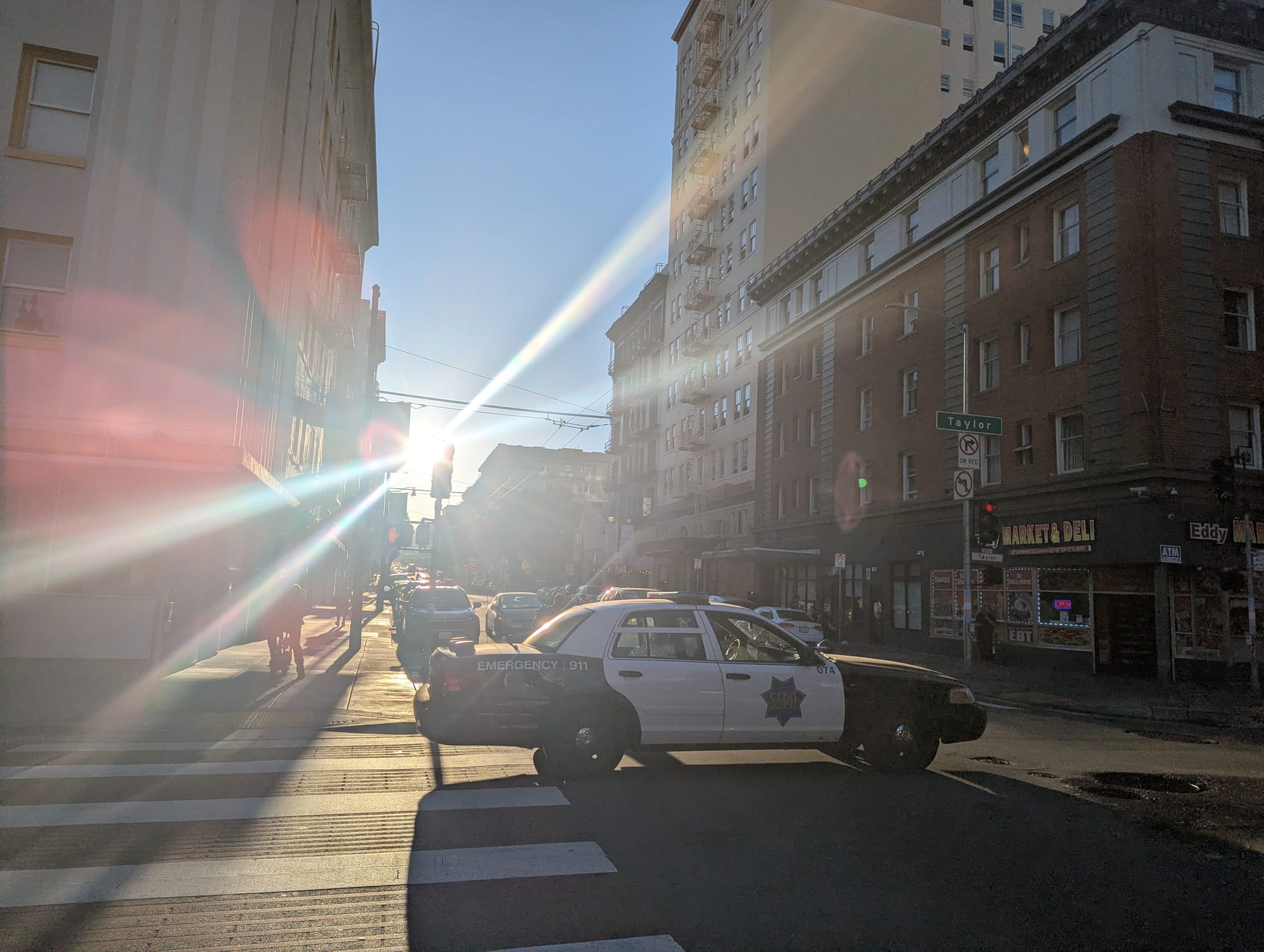
As a kid, going to San Francisco meant visiting my grandparents. Our family’s minivan would swerve onto Taylor Street and turn right after passing the Golden Gate Theatre, arriving at an area bustling with people. I’d notice that there was something off with my family’s behavior. My mom squeezed my hand tighter than usual, guiding me as we snaked through the crowd. It was as if she was determined to make it inside my grandparents’ building, trying to outrun something that I couldn’t see. At the time, I thought she just didn’t want me to get lost, or maybe she had to use the bathroom. But as the years passed, I better understood her.
In late 2024, as an adult just out of college, I moved to the Tenderloin to live with my grandparents in their studio apartment.
I found that it was embarrassing to admit to others that I lived in this neighborhood. Not because I hated it, but because of everyone’s negative perceptions of it. Many people, like my mom, found it threatening. So only my close friends in the Bay knew the truth. Everyone else got a white lie wrapped in a bow.
Google says I’m in the micro-neighborhood of the Theater District. It’s so small that most people don’t know where it is, and neither does the dating app Hinge, which lets you drop a pin on a map showing the general area where you live. When I set up my user profile, my fingers moved the pin a few centimeters south, landing me in the Mid-Market area.
Most of my tech coworkers were transplants from other cities and countries. When they asked where I lived, I always said “around Mid-Market,” telling a half-truth.
I didn’t want them to think less of me, which would have been likely, based on what I gleaned from conversations around the office. To no surprise, many made disparaging statements about the people in the Tenderloin, almost blaming them for their situations. It was discouraging to hear this, since my colleagues probably hadn’t ever talked with residents of the neighborhood. They viewed it as ridden with crime and illicit substances. They came from more affluent neighborhoods, like the Marina and the gentrified part of Mission, or lived in those luxury high-rise apartments crowding SoMa and Civic Center.
I lived in a walk-in closet with an exposed light bulb.
I believed that all TL residents shared my shame and wanted to move to a “nicer” part of the city. The neighborhood was the butt of every joke, the scapegoat boogeyman blamed for all of San Francisco’s problems.
An honest conversation with my grandmother changed my outlook.
“What’s a good location for someone to pick us up?” she asked one day in Tagalog. For some reason, she didn’t want the car to come directly to our street.
I helped her browse the map and decide on somewhere near 5th and Market. I asked what this was for, and she said that a coworker was going to pick them up.
I didn’t sense any shame or embarrassment but, just to make sure, I asked her if she felt that way about living here. She said no. She explained that she was directing her coworker elsewhere so that they would feel more comfortable, since the Tenderloin contains bad elements that can frighten people. But it also contains good, and she accepted that. She’s seen the area change through the decades and has embraced this duality.
This interaction prompted a self-examination. I realized that my own negative feelings wouldn’t dissolve on their own. I had to stop wallowing and help that happen, and make the most of my situation, embracing both the good and bad parts of the Tenderloin.
I took another step in that direction during the 2025 Academy Awards season. During an interview for a series called Actors on Actors, Colman Domingo talked candidly about living in the Tenderloin in his 20s. He’d lived in a studio apartment with three other guys while acting in local theater productions. Domingo described the neighborhood as having “women of ill repute,” but showered it with a lot of love: It was fun and full of artists, and it was cool living there.
I paused the video, rewound it, and listened to his words again. Domingo had the eyes of Academy voters and didn’t hide that he previously lived here. There were also parallels to our stories: We both moved to San Francisco in our 20s after college and shared a small apartment with roommates. Granted, my roommates were a little older and the TL in the 1990s was probably somewhat different. Nevertheless, Domingo’s pride made me comfortable slowly revealing my truth.
One day, a work friend and I made plans to meet at an event and got to talking about where we’d be coming from. I prepared myself, and then I came clean and told her that I was living a lie. I didn’t live in Mid-Market, but the Tenderloin.
“I don’t care that you live in the Tenderloin,” she said.
Those few words killed any remaining neighborhood shame.
The more people I met, the more I mentioned living in the TL. It was a matter of fact, like “The sky is blue” or “Water is wet.” I’d initially suspected that my coworker’s reaction had been a one-off, but it wasn’t; when I mentioned the Tenderloin, people just nodded and the conversation naturally moved on. Many who didn’t care had lived in the city for years; it was just the transplants who couldn’t handle the idea of a car horn blaring at 9 p.m. on their block.
Yes, there are problems in the Tenderloin and I am not actively ignoring them. But there is also a rich culture and history, easy access to transit stops, great food spots, and people just trying to make it in one of the most expensive cities in the U.S.
I eventually encountered the type of response I used to fear, and the memory gets funnier and funnier in hindsight. At a friend’s birthday party, someone asked what neighborhood I lived in. “The Tenderloin.” My delivery was neutral with no sense of embarrassment or loathing. This had become my weapon to gauge how cool people were.
Those four syllables left my mouth and hit him hard. His eyes widened, brows raised and mouth agape, almost as if I’d said I lived in an active war zone. He shot concerned statements like a worried machine gun. “When I lived in Mid-Market, it was bad so I can’t imagine how it is there.” “Aren’t you concerned with the homeless?” “You’re a pretty small guy. Do you feel safe?” I dodged these bullets and fired back answers. His concerns were valid, but the embarrassment didn’t faze me anymore. These were things I’d grappled with before and an overdramatic reaction was not going to put me back in the neighborhood closet.
The shame pops up periodically, but I treat it as a game of Whac-A-Mole, attacking the shame with things I love about the Tenderloin. I see outreach workers working with the unhoused on my morning commute, and I’m grateful that people are getting the assistance they need. There are amazing views of the city’s architecture that you can’t get anywhere else. And sometimes, despite living together, I bump into my grandparents returning from their walk to the Ferry Building or farmer’s market during my errands. My only wish is to have accepted this place sooner.
Every neighborhood in San Francisco has its problems, which put mine into perspective. The Sunset is always cold and housing is so flat, many areas in SoMa are too car-dependent, and I always have to play human Tetris riding the 38 bus in the Richmond District. But embracing the Tenderloin made me find the beauty in all its nooks and crannies. It’s not perfect, but I call it home.

At the ribbon-cutting for Café Melange, Mayor Daniel Lurie acknowledged the work of local entrepreneurs.

At the unveiling of “Stephen Tennis Way,” friends reminisced about the local hero who touched many lives.


The trees that inspired an appeal are gone. The ability to make that type of appeal could be next.
