
Hospitality House is continuing the fight to stay in SoMa
On the steps of City Hall, staff and supporters of the organization’s Sixth Street Self-Help Center rallied around finding it a new home nearby, and told stories of its positive impacts.
On the steps of City Hall, staff and supporters of the organization’s Sixth Street Self-Help Center rallied around finding it a new home nearby, and told stories of its positive impacts.

Awards went to residents, businesses, and even pets. Special activities are happening through Sunday.

The city is conducting a needs assessment to help inform programming and budget decisions.

Closing the center would make the care it offers inaccessible to neighborhood residents, Hospitality House says.


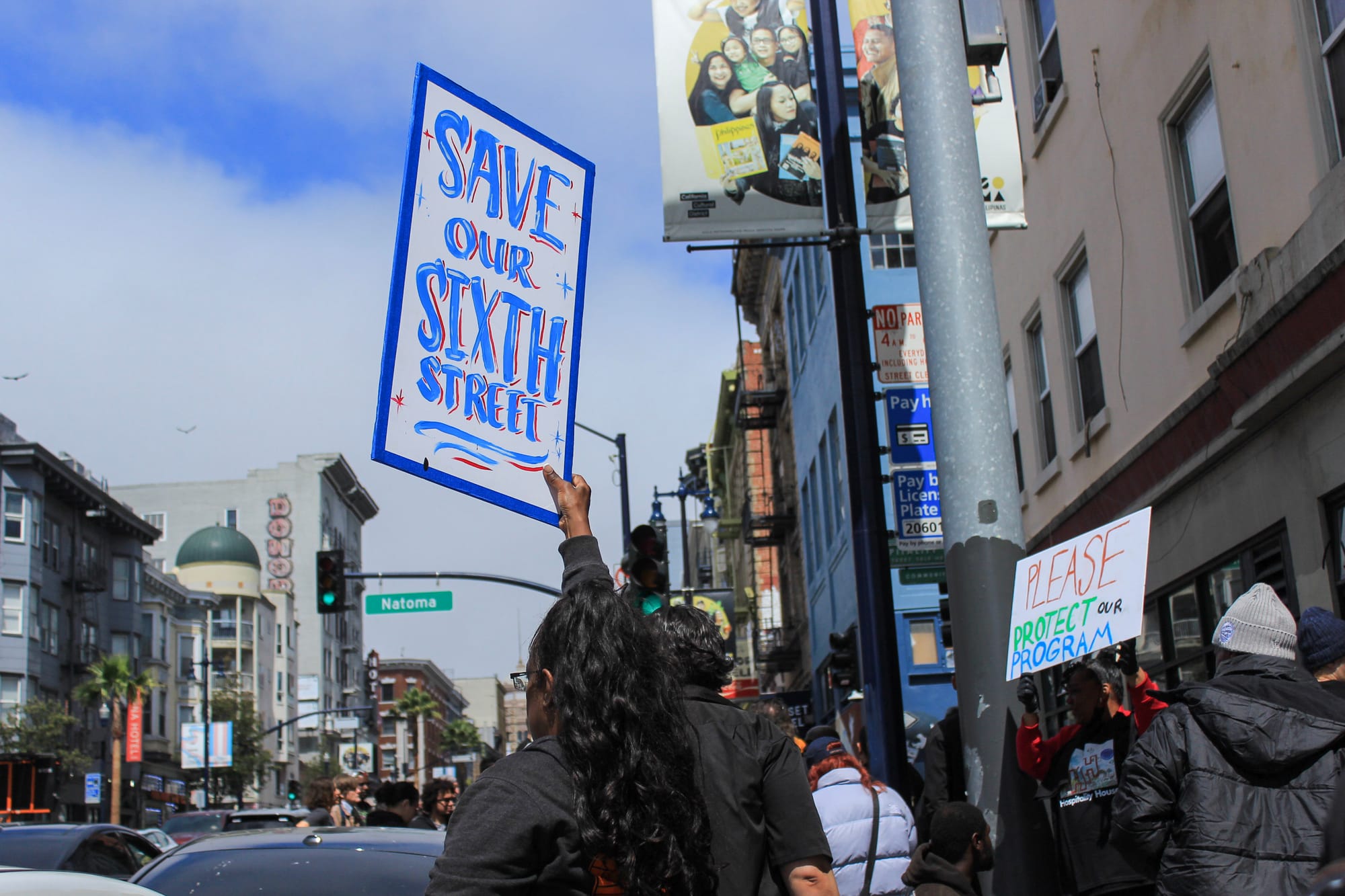
Volunteers, staff, and community members of Hospitality House rallied at its Sixth Street Self-Help Center Wednesday afternoon to apply public pressure in favor of keeping their space. City leaders are moving to close the facility by the end of the year.
Allies of the center gathered on the sidewalk on Sixth Street to hear speeches, play chess, and drink coffee. They played music, waved homemade signs, and garnered plenty of supportive car horns from passing traffic.
Their goal between now and Dec. 31 is to pressure city leaders to change their minds about closing the SoMa location.
Hospitality House is a nonprofit organization, founded in the Tenderloin in 1967 to offer free support services to anyone who walks through their doors. Its SoMa location, a 20-year staple on 6th and Natoma streets, offers hygiene kits and fresh clothes, group and individual therapy, hot coffee and meals, case management, and a space to charge a phone, play a board game, or paint a picture. The Sixth Street Self-Help Center is open every weekday from 9 a.m. to 10 p.m.
If the SoMa location shutters, its operations would have to be consolidated with Hospitality House’s Tenderloin Self-Help Center on Leavenworth Street.
Hospitality House leadership are convinced that would make the program inaccessible for their SoMa community.
“Four thousand people aren’t going to follow us to the Tenderloin,” Executive Director Joe Wilson told the Tenderloin Voice, estimating how many people the Sixth Street Self-Help center serves per year. Among those are plenty of elderly and disabled people.
“The idea is to have resources in the community where people live,” Wilson said. He pointed out single room occupancy hotels along 6th Street that house the people who come to the center for care.
To the Hospitality House community, its long tenure at the site has been key in serving the SoMa neighborhood.
“The success of what we’ve been able to do is because of our presence in the community,” Wilson said.
Hospitality House as a whole operates on a harm-reduction model, which doesn’t require abstinence from participants who struggle with substance use in order to work with the center to improve their living conditions.
“Our belief is that people still get to make choices. If we want people to make better choices, we are duty-bound to provide better options,” Wilson said. “We’re connecting people to housing, we’re connecting people to jobs, we’re connecting people to treatment, we’re connecting people to better choices.”
Cherie Davis has been the program manager at Sixth Street Self-Help Center for 13 years. She initially came to Hospitality House after a relapse and was moved by the community to become someone who could help others struggling like her.
She starts every day at the Sixth Street Center with hot coffee and a meal for the community members who come through. People check in with each other before they begin their day. Then they will see their case manager, attend or schedule a therapy session or doctor’s appointment, or connect with their community.
“I’m these people, here,” Davis said, gesturing to the dancing crowd on the corner of Sixth and Natoma. “This is who I am.”
Sonya Duty, a program participant of the Sixth Street Center and volunteer peer specialist, has been with Hospitality House for more than 30 years. She credits the organization with helping her through school, an internship, getting and retaining housing and a job, lifelong friendships, and a new set of teeth.
“[Sixth Street Center staff] know what we’re going through. They don’t judge us, and they don’t look down at us,” Duty said. “I was born and raised here. I was scared over here. But these people here, they work with me. They help me. If they close, where am I gonna go?”
The mayor’s office has not stated exactly why the center has to close. Neighborhood community groups around the Sixth Street Center have filed formal complaints both to San Francisco and to the state about loitering, disruptive behavior, and littering along the 6th Street corridor and about the concentration of service providers in the area.
However, city leaders have not cited those complaints as the primary motivation for shutting down the center, and at least one local group denied specifically asking for the SoMa Hospitality House location to close.
Donations from the community help the Tenderloin Voice compensate reporters, storytellers, poets, and other contributors for their work.
A few blocks south of the Sixth Street Self-Help Center is the sheriff’s RESET Center, a place where law enforcement can bring people who are engaging in illegal activity and who officers believe are drunk or high. City leaders have touted it as an alternative to county jail.
The RESET Center has been open since May 2026. The Hospitality House community says that RESET staff don’t have the years of experience and relationship-building it takes to understand the needs of the people they serve.
“You don’t build trust by putting people in handcuffs,” Davis said.

On the steps of City Hall, staff and supporters of the organization’s Sixth Street Self-Help Center rallied around finding it a new home nearby, and told stories of its positive impacts.

Awards went to residents, businesses, and even pets. Special activities are happening through Sunday.

The city is conducting a needs assessment to help inform programming and budget decisions.

The popular program pays musicians to play for the public, including in the Tenderloin. Interested artists can apply until Oct. 1.

Stay tapped into the Tenderloin: Our email newsletter sends every article to your inbox. Unsubscribe anytime.