
Tomorrow: The TL votes together, and you can join
If you want things to change, Windy Click wants you to vote, and she’ll take you and everyone else to City Hall to get it done.
If you want things to change, Windy Click wants you to vote, and she’ll take you and everyone else to City Hall to get it done.

The Tenderloin is full of life. It is not a bleak hellscape. A recent video game made my community the backdrop to dehumanizing violence. This depiction could not be farther from reality.

A revamped mural at 826 Valencia Tenderloin Center features student poetry.

These rescuers help pigeons whose feet have become tangled in debris. Spending an afternoon with them changed the way I see urban wildlife.

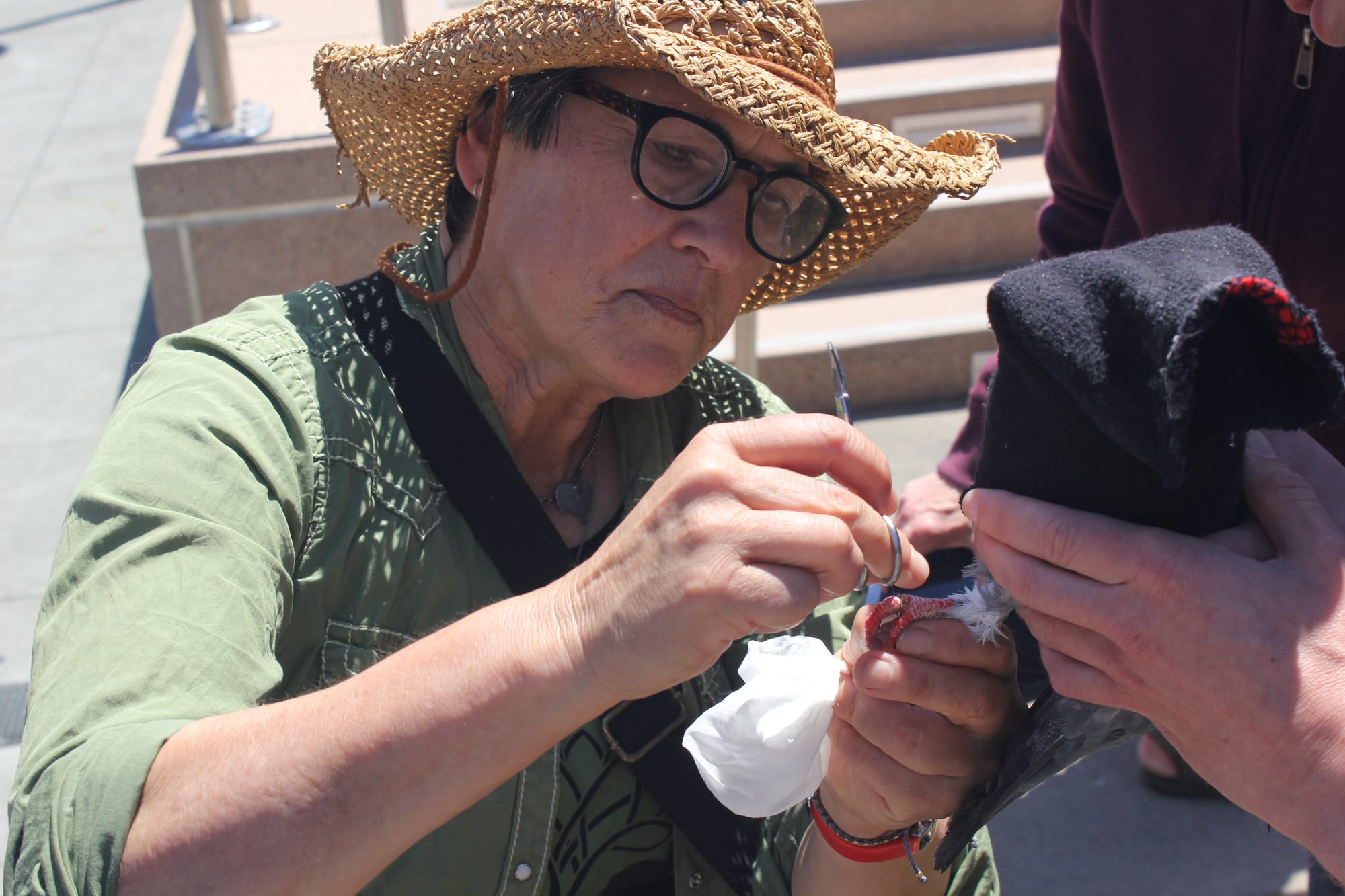
In a sun-drenched patch of grass at Union Square, a flock of pigeons gathers around Carla Cabral. She is half-crouched and her gaze is fixed on a spot right in front of her toes. I only realize she’s made a move when the flock explodes into flight — she has darted out her arms, moving faster than I thought humanly possible, and when she straightens, she’s holding a bird. Her grip appears gentle, but secure.
A companion hurries over to her with a crew sock. They pull the sock over the pigeon’s head and shoulders, and I can’t help it — I picture a kidnapping. But the bird, who had been struggling to get free, settles, apparently calmed.
“It looks kind of violent when we catch them,” admits Dany Petelle, who has been making these excursions for eight or nine years. She says she almost wishes more people who see her group grabbing birds would stop to demand an explanation. She wonders why they don’t react with concern.
So what are they doing? The group of about a dozen people is traipsing through the urban jungle on a mid-June morning not to harass or steal pigeons, but to help them.
Every second Sunday of the month, Cabral gathers volunteers for an animal liberation group called Direct Action Everywhere (often abbreviated DxE) and leads them through the area around Powell Station in downtown San Francisco to find birds whose feet have gotten wrapped in hair, string, and other strands of man-made materials. The birds can’t untangle themselves, and their toes can become deformed or even fall off entirely. You’ve seen that before — pigeons with club feet or missing digits. So these helpers nab the birds and painstakingly unwrap and cut away the offending debris, disinfecting any wounds as they go.
Earlier, before the group set out for the day, Cabral gave a primer course on pigeon care, delivered with an ease and speed that comes from years of practice. She had also brought pet food, portioned out into easy-to-carry bags to give to unhoused people with dogs.
Anyone can join the group and learn the basics of pigeon first aid. But Cabral, a paid fellow with DxE, is a consummate animal liberation activist. Helping the pigeons is one of her passions. Today she is decked out in pigeon-themed adornments, from the print on her shirt down to her expertly painted nails, which feature tiny bird portraits. She is eminently qualified for this work, having spent about a decade as an emergency veterinary technician. And she is deeply devoted to the cause, even ready to go to prison for animal rescue operations.
Yes, prison. Until recently, Cabral was facing more than six years for a DxE initiative that had her entering a goat dairy to investigate conditions there. She and her co-defendants captured video of what they saw: goats that were emaciated, ill, or dead and left in a pile. They whisked away an ailing mother and two kids to be nursed back to health. In August, a judge reduced the felony theft and other charges down to misdemeanors. But the goat rescue wasn’t the only time Cabral has faced potential incarceration, and it probably won’t be the last. She could get more than 12 years for charges brought after a different operation, involving taking dogs from a company that bred them as laboratory test subjects.
The Tenderloin Voice tells stories like this one with care. Help keep us in the community.
The point of these actions isn’t just to rescue animals, although that sometimes becomes a moral imperative for the activists (“I will never apologize for saving someone’s life,” Cabral says). It’s to find and reveal the abuses that go on behind closed doors and bring about meaningful change. The dog breeder, for example, was shut down. Cabral regards the risk of incarceration in pursuit of these goals with a kind of brass-tacks serenity.
“I live in my car,” she says. “I’m lucky enough, I have carved a path in my life such that I am unburdened with things like ‘Oh my god I’m gonna lose my law license,’ or ‘I can’t be a teacher anymore.’”
She has no human dependents. She is “not worth very much, monetarily.”
“I have lived my life in a way that has led me to put the animals and injustice first,” she says.
Her top priority is that if she goes away, someone looks after her companion animal — and, of course, that the pigeons continue to get care.
While it isn’t exactly clear who would lead the pigeon detangling excursions in Cabral’s absence, there’s no shortage of interest in helping out. The cohort I joined has both veterans and bright-eyed cadets.
Holly Taylor, a long-term volunteer working with cats at Animal Care and Control, is new today, and finds the experience of holding a bird for treatment exhilarating.
“He could tell we were helping him. His heart rate was so fast at the beginning,” Taylor says. When she offered the patient her pinky finger to grab onto with one foot, she felt that heart rate go down. “Animals know kindness.”
“It’s an amazing experience,” Taylor says. “We don’t think about these animals, how they live with us and how they can’t help themselves.”
Sophia, a student at a Bay Area high school, is also helping the pigeons for the first time. She, too, has so far on this trip been limited to holding the pigeon while a more experienced volunteer tweezes and snips between the birds’ delicate, slender toes.
She was drawn to this group out of a desire to get more involved in community and volunteer efforts.
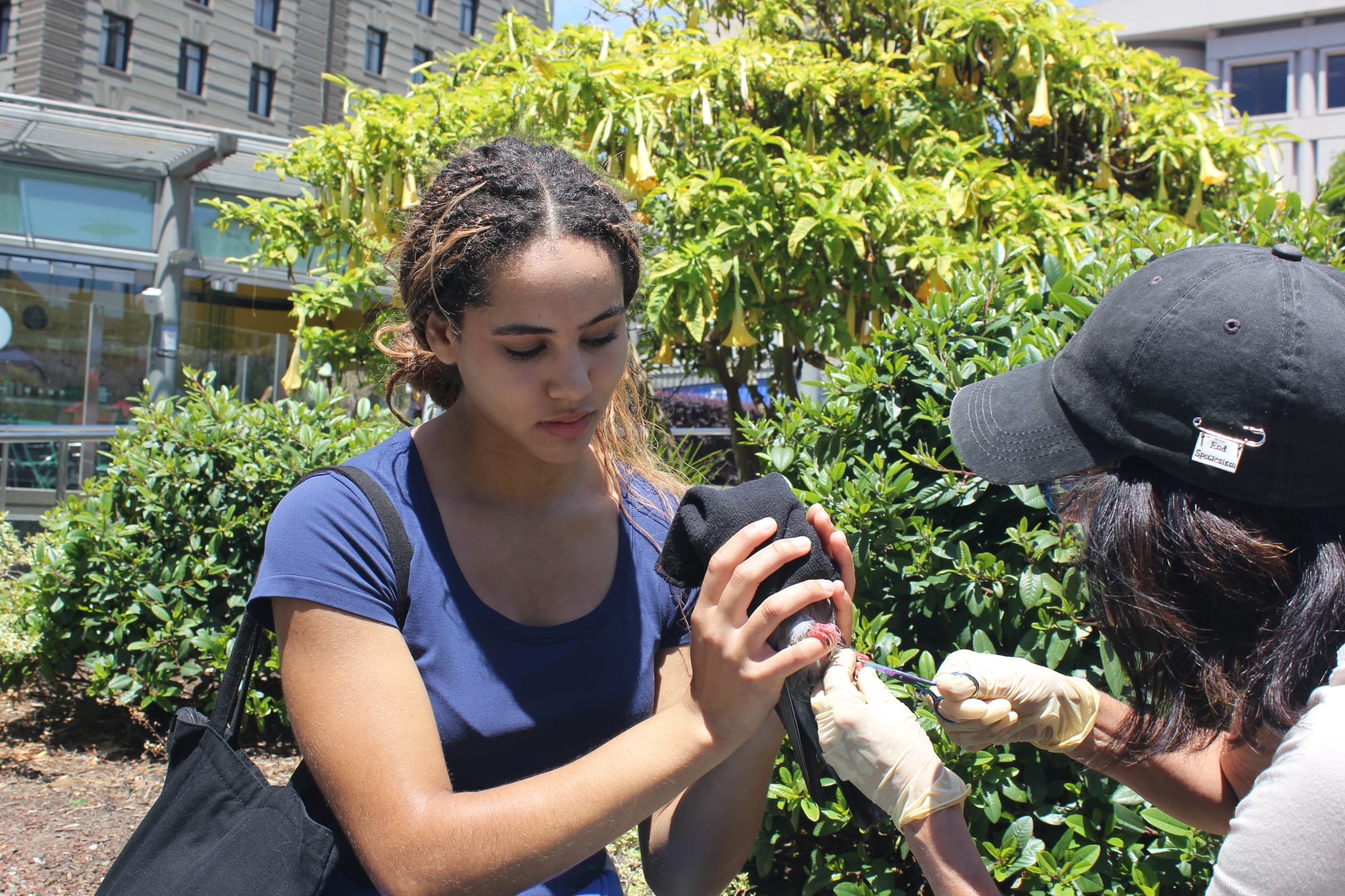
“If you’re feeling hopeless, start with your community, start with the small things around you,” Sophia says.
Kim Sinder, on the other hand, has been a friend to pigeons for years. Even before she joined DxE’s roaming rescue band, she connected with a flock near a job at the Ferry Building. They got to know her and would perch on her knees, shoulders, and head. She named her closest feathered friend “Birdie.”
“They were my gang. I really came to love and appreciate them,” Sinder says. When I ask about mites and disease, she tells me she’s never caught either from the birds. Perhaps inferring what could be behind my question, she expresses dismay at how people deride pigeons as dirty, and says that she hates the term “rats with wings.”
“It pisses me off because it couldn’t be farther from the truth,” she says.
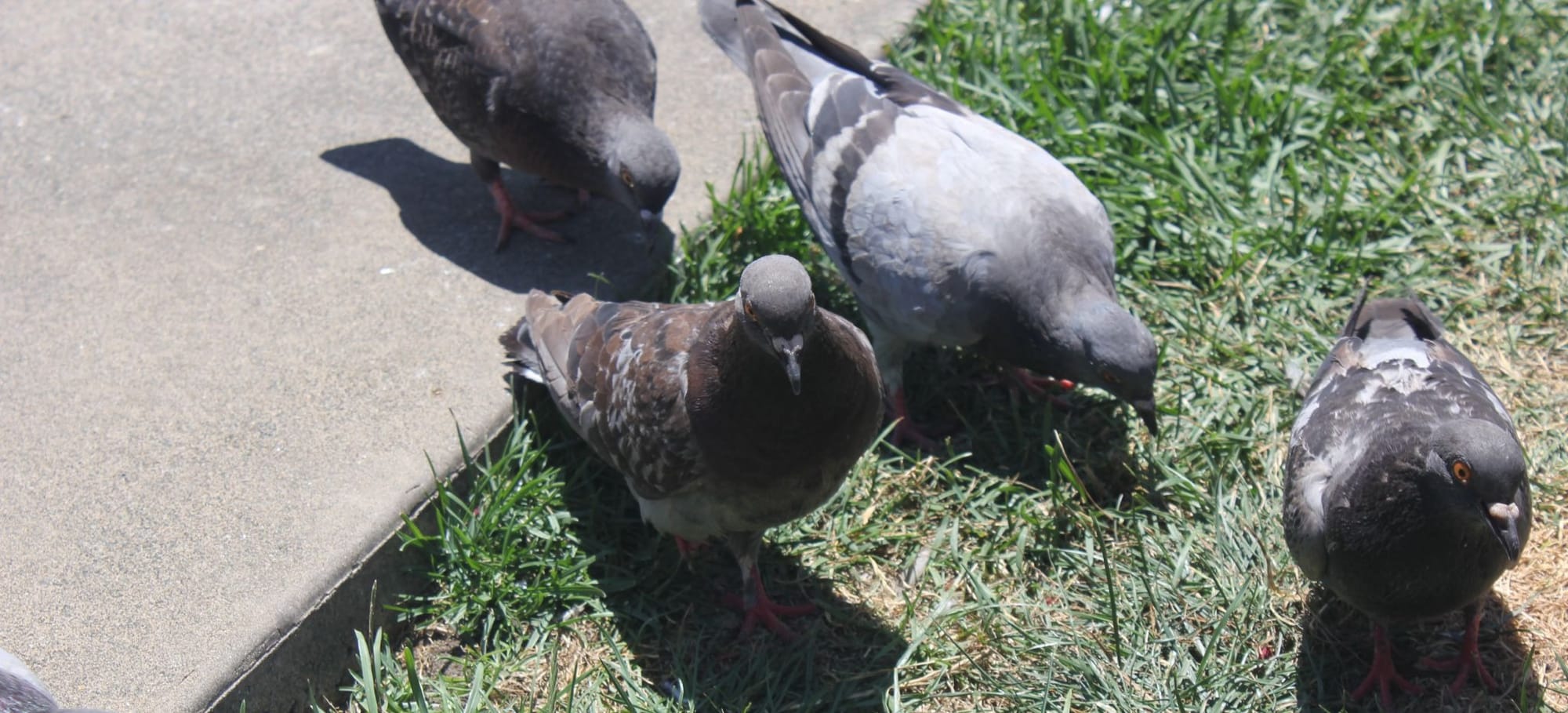
The pigeons that pick at crumbs around café tables and roost on windowsills live in the margins of our urban landscape because humans brought them here and then abandoned them. They have adapted from nesting on cliff faces, in extremely unforgiving conditions, to urban environments. Most are descended from domesticated doves. These were kept as livestock, companion animals, or working birds carrying messages for a communications system that has become little more than an obscure hobby.
For most people, these birds blend into the background of the cityscape. But DxE’s rescue efforts draw attention to them. And usually, it’s admiring curiosity.
That has happened often during the group’s visits to the Tenderloin, Sinder tells me.
“Unsheltered people would come up and ask what we were doing and say, ‘god bless,’” she says, remembering. “It just warms your heart.”
At one point during our outing, a girl stops in her tracks, clamoring to get a closer look. She and Sinder swap pigeon stories for a bit, agreeing that they are very sweet birds.
On our way out of Union Square, heading toward the Tenderloin, the group intersects with a film crew recording something. We’re in the process of just passing by one another, but then Cabral suddenly strikes, snatching a lone bird off the ground. The film crew stops, shocked. Petelle explains what they’re doing.
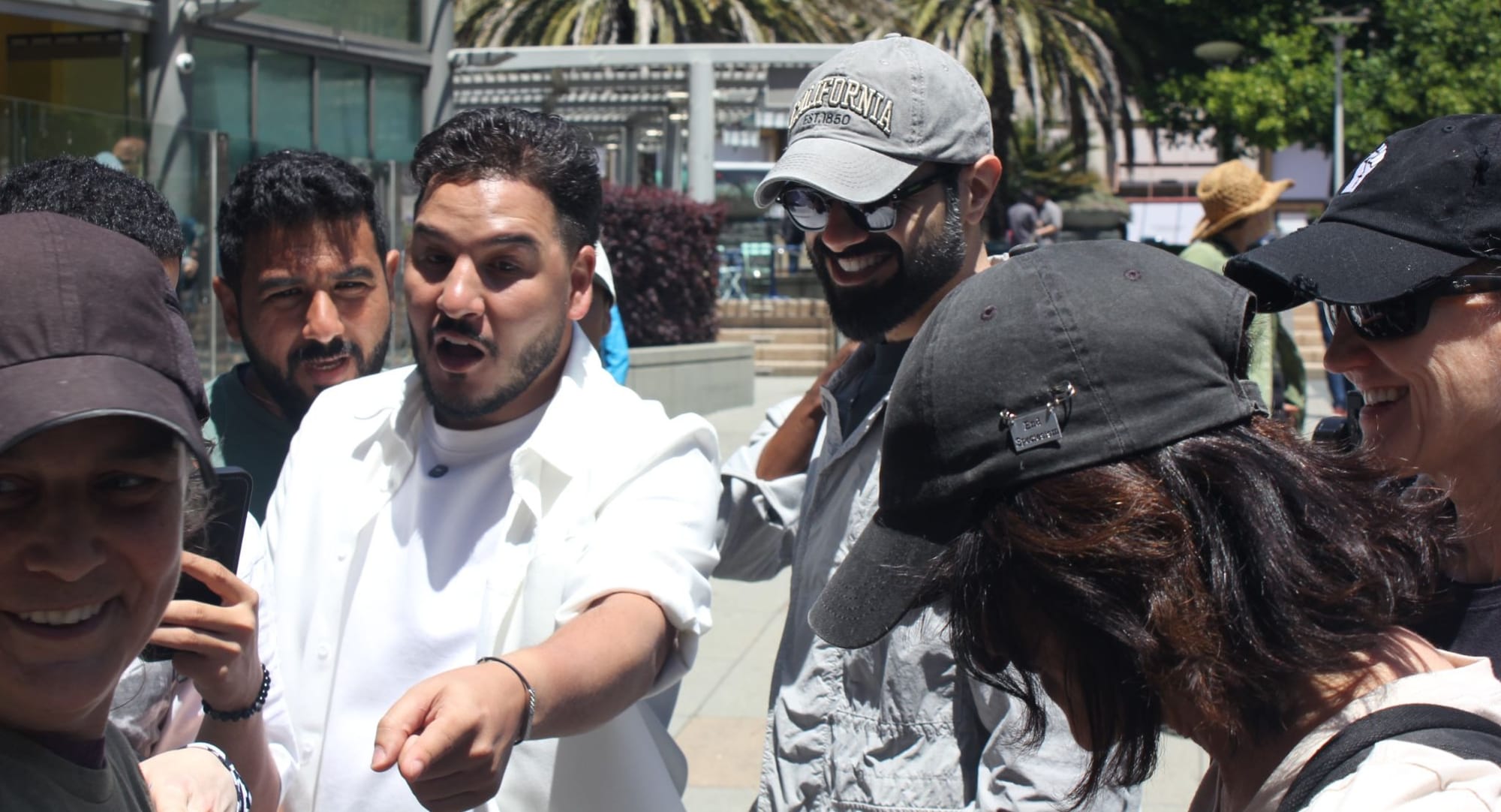
Two of the crew’s members come in close, looking at the bird, taking in what’s going on. A phone goes up to record. The film crew starts to get more enthusiastic, praising the rescuers. Then one of them points to the talent they’re accompanying, saying, “You know, he’s got like 27 million followers!” It’s Mohamad Adnan (Instagram handle @mohdadnan23), a soccer-focused influencer with a huge audience in Arab communities around the world.
The groups peel apart again, Adnan to address his followers, DxE to minister to more pigeons. It’s a friendly, mutually appreciative parting.
There have also been more hostile interactions, the volunteers tell me. Security guards and park rangers sometimes tell them off for feeding the pigeons. While it certainly isn’t the group’s mission to give them food, it’s often necessary to draw the birds within grabbing distance, even for the most experienced rescuers. Learning about these reprimands is a reminder, to me at least, of how so many people see pigeons: as vermin.
It’s an attitude that Cabral rejects. She treats them and talks about them as individual souls, worthy of care and dignity.
At one point, I ask her if the volunteers ever encounter other ailments besides tangled feet. They do, she says, and in the event a bird is afflicted with something serious, they can bring the patient to a wildlife care facility in Marin. But for Cabral, that option requires grave consideration because it could carry the ultimate consequence: If the bird is too unwell to be released after rehabilitation, euthanasia is the only outcome.
“If I’m dying, I would rather die outside with my friends and family than be carted off to a hospital with people I don’t know,” she says.
I can relate to that.
Then I learn: If a patient recovers enough to be released back into the city, Cabral takes pains to bring them back where she caught them. “Because they have family!” she says.
As I part ways with the DxE group to cover my next story, I realize I’ve fully adopted her mindset. It’s a meaningful transition for me, even as a years-long vegan. If I’m honest, my mentality is ordinarily quite anthropocentric, and I maintain a strict leave-each-other-the-hell-alone policy with wildlife.
But I find that the rest of the day, as I’m shooting photos of people and streetscapes, I keep noticing the birds — a flare of wingtip here, the blink of a round, luminous eye over there. I’m seeing them now, and thinking about their lives.
If you’d like to join the volunteers and learn how to untangle pigeons, you can find the events on DxE’s Facebook page. The next pigeon care outing is scheduled for Sept. 13.

If you want things to change, Windy Click wants you to vote, and she’ll take you and everyone else to City Hall to get it done.

The Tenderloin is full of life. It is not a bleak hellscape. A recent video game made my community the backdrop to dehumanizing violence. This depiction could not be farther from reality.

On the steps of City Hall, staff and supporters of the organization’s Sixth Street Self-Help Center rallied around finding it a new home nearby, and told stories of its positive impacts.

Awards went to residents, businesses, and even pets. Special activities are happening through Sunday.

Stay tapped into the Tenderloin: Our email newsletter sends every article to your inbox. Unsubscribe anytime.