
Hospitality House is continuing the fight to stay in SoMa
On the steps of City Hall, staff and supporters of the organization’s Sixth Street Self-Help Center rallied around finding it a new home nearby, and told stories of its positive impacts.
On the steps of City Hall, staff and supporters of the organization’s Sixth Street Self-Help Center rallied around finding it a new home nearby, and told stories of its positive impacts.

Awards went to residents, businesses, and even pets. Special activities are happening through Sunday.

The city is conducting a needs assessment to help inform programming and budget decisions.

A neighborhood art gallery’s exhibition invites you to reflect on migration and identity, whether you feel foreign, split, or at home.


Artist Alexandru Salceanu’s latest work takes myriad immigrant stories and weaves them together — literally.
On long strips of canvas, people are invited to write their thoughts and feelings about what concepts like “home” or “identity” mean to them. Salceanu then joins the strips with others in a tapestry of diverse voices and experiences.
The art piece has grown over time and led to serendipitous moments.
During one showing, “the mother of someone who came to visit was relaying her life story” as they discussed the artwork, Salceanu said. It became an opportunity for her son to know her more deeply. The son said, “You shared more here than you shared with me,” Salceanu recalled.
Called “Interwoven Histories,” the full exhibition contains the weaving project as well as two other works by Salceanu that tap into the themes of human migration. It is on display at TnT Art Lab, at 67 Turk St., where Salceanu is artist in residence. Members of the public can add to it this Wednesday, from 5:30 p.m. to 8:30 p.m., and on Sept. 5 during the same hours.
Consider dropping by and adding yourself to the weave. If you know someone who might be interested, send them this story. This is the Tenderloin, after all, a neighborhood home to immigrants from all over the world. There are so many languages here that not one, not even English, is spoken by a majority of residents at home.
The reflections shared by members of this community will then travel on to new audiences. Salceanu will show the artwork at three more locations in the coming months, elsewhere in San Francisco as well as in San Jose and Point Reyes. For details about those showings, scroll to this story’s end.
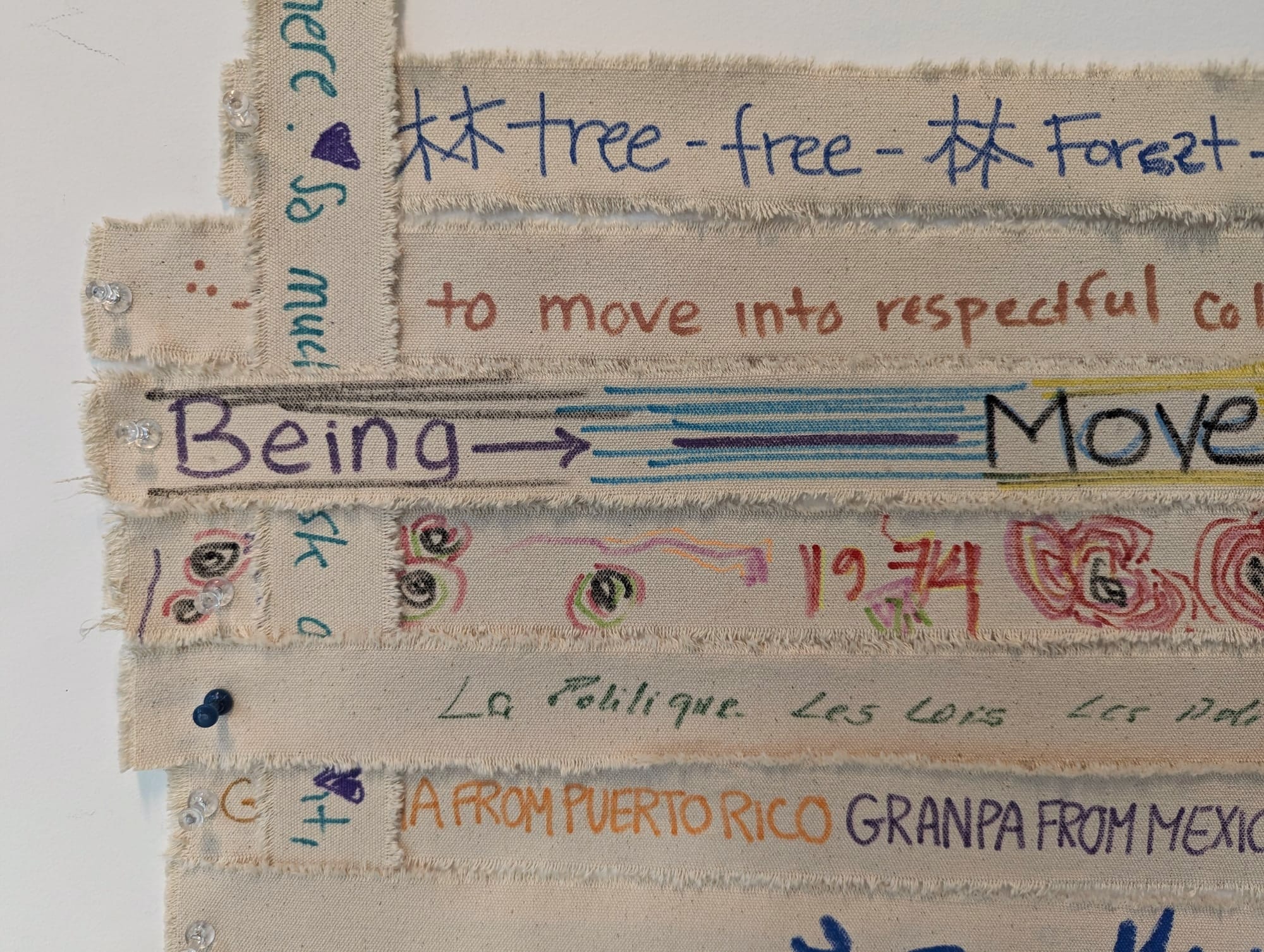
Some of the statements left by others feel profound.
Salceanu pointed to one.
“It’s a Romanian saying: ‘Having your butt between two boats,’” he said. The phrase describes the feeling of carrying dual identities.
Another reads, “Living someone else’s dream for 20 years, and then finding myself here.”
“And some of these, which are in Arabic,” Salceanu said, “they’re poems from Palestinians about having your land taken away and being a foreigner in your own land, or treated as such.”
Other statements are simpler, yet still quite personal. They include “San Francisco,” “Home means love,” and “I am not American enough!”
Donations from the community help the Tenderloin Voice compensate reporters, storytellers, poets, and other contributors for their work.
When you write yourself into the piece, you don’t need to come up with something specific or explain it in depth. What’s important is the moment that happens when you write whatever comes to you. That moment is the goal of this participatory art.
The exhibition’s two other works might stir something in you that belongs on the canvas.
One, called “AlieNation,” is a series of long-exposure photographs of the night sky and landscape, showing light trails left by stars, planes, boats on the Bay, and cars on the Golden Gate Bridge. It’s a study of the movement of people.
And Salceanu’s “Witness Collaborative” is the work that gave rise to the canvas-weave project. It’s a series of video interviews with immigrants, chronicling their or their families’ stories of leaving their home countries. He created them in cooperation with the interviewees, even going so far as to involve them in the video-editing process.
If you’re standing outside TnT Art Lab, on the southeast corner of Turk and Taylor streets, you can see the videos through the tall glass windows. You can’t hear the audio, but there are subtitles. One of Salceanu’s subjects was his mother. In her video, she recounts leaving Romania after the country’s 1989 revolution.
“My family was persecuted during communism,” Salceanu said. “We were blacklisted, with the secret police always monitoring us and trying to arrest my mom on several occasions.”
The government’s widespread informant system was targeting his mother for protesting the regime, and also for her work. She taught English, and her students maintained pen-pal correspondence with people in the United States and United Kingdom, “which was viewed as maybe a treasonous act during communism,” Salceanu said. “She wasn’t a part of the Communist Party.”
When she spotted an opportunity to temporarily get away to the U.S. with her sons, she took it. In 1992, they were couch-surfing in America, staying with friends and extended family. Then the stars aligned, and she found an American company that needed someone fluent in Romanian. Suddenly she had a green card, which allowed them to stay permanently.
Salceanu brought deep empathy to this and the other interviews he filmed, thanks in part to his recent experiences in the Philippines, he said. His wife was running an immersion program there for students at the University of San Francisco, while he worked with organizations that provided social services to some of the country’s poorest people. Constantly engaging at the grassroots level, Salceanu developed a yearning to help people tell their own stories in their own ways — and to avoid trying to fit them into his narratives about them.
It was while showing the “Witness Collaborative” video series last year that he realized something was missing from the work.
During an exhibition, a viewer “came to me crying, saying, ‘My own experience is so similar to this person’s,’” Salceanu said. “So that’s why I was like, the audience is intaking, digesting this really powerful story, so how can they also have a release at the same time?”
Soon, the canvas-weave project was born.
The work has a fitting home at TnT Art Lab, said founder Bradley McCallum, who wants the space to host pieces by artists “who are engaged outside of their studio practice, and involving the community directly in thinking about and making the work.”
The Art Lab began operating late last year, and McCallum said he hopes to open it to the public full-time starting this October. In the meantime, people can see the space by appointment, or show up most Wednesday evenings for special events like artist talks, presentations, or poetry readings.
One poetry reading happened this month.
The Tenderloin has had “a bad rap” for a long time, said Genny Lim, San Francisco’s current poet laureate, at the event. Not many people know about “these little cultural hubs and oases that artists have revitalized,” she said.
“The problem is that a lot of people are afraid to come out these days because they’re being targeted by ICE,” Lim said. She lamented that many might feel safest in their tiny single-room occupancy hotels, when they’d prefer to step out and “mingle and interact with people and artists.”
Alejandro Murguía, the city’s poet laureate from 2012 to 2015 and a professor emeritus at San Francisco State University, was also excited about the art space and exhibition.
“Every neighborhood needs a cultural center, needs galleries, needs spaces for poetry readings, for theater, for dance, right?” he said.
This artwork, including the woven statements, will travel to the following locations:

On the steps of City Hall, staff and supporters of the organization’s Sixth Street Self-Help Center rallied around finding it a new home nearby, and told stories of its positive impacts.

Awards went to residents, businesses, and even pets. Special activities are happening through Sunday.

The city is conducting a needs assessment to help inform programming and budget decisions.

The popular program pays musicians to play for the public, including in the Tenderloin. Interested artists can apply until Oct. 1.

Stay tapped into the Tenderloin: Our email newsletter sends every article to your inbox. Unsubscribe anytime.