
Sunday Streets could end. Advocates will rally today to keep it.
The rally happens at 3 p.m., an hour before a City Hall meeting to discuss proposed funding cuts to the event.
The rally happens at 3 p.m., an hour before a City Hall meeting to discuss proposed funding cuts to the event.

At a meeting in the Tenderloin, officials talked plans for making the neighborhood and San Francisco safer this year.
The police chief, district supervisor, and others will field questions from the public. All are welcome.

At a meeting in the Tenderloin, officials talked plans for making the neighborhood and San Francisco safer this year.

San Francisco’s top public safety officials gathered in the Tenderloin Thursday night to talk about their plans for the year, previewing a forthcoming sobering center and promising to step up fire prevention and drug-dealing deterrence efforts in 2026.
District Attorney Brooke Jenkins, Sheriff Paul Miyamoto, Fire Chief Dean Crispen, and newly appointed Police Chief Derrick Lew convened before a packed room of about 100 people, many of them standing along the walls. The event was organized and moderated by District 5 Supervisor Bilal Mahmood, who threw the officials his own questions and a selection of inquiries from attendees who had submitted them beforehand.
Many people seemed pleased with the event, though one community leader expressed frustration over how attendees couldn’t ask the officials questions directly during the meeting.
The RESET Center surfaced many times throughout discussions — the backronym stands for “Rapid Enforcement, Support, Evaluation, and Triage.” The center is slated to open in April and billed as a kinder alternative to conventional settings for people to wait out their debilitating or disruptive intoxication.
Temporary detainees will each get reclining chairs, rather than being crammed together in a tight, shared space like the holding cell at the city’s jail. In this more “therapeutic environment,” Sheriff Miyamoto said, people will hopefully be more willing to accept services that might help them manage addiction.
We at the TL Voice have heard from many community members who want to know more about the RESET Center. We’ll be looking for stories to tell about it.
Fire Chief Crispen recounted recent devastating blazes in the Tenderloin, perhaps the worst of which happened in December, displacing 68 residents from the building at 50 Golden Gate Ave.
“While I think we do a pretty good job of extinguishing [fires], I think we have to do a better job of preventing them,” Crispen said. “And that’s what we’re really working on in 2026.”
“We found that a lot of our fires in 2025 were caused by two things. One was hoarding, and the other was lithium-ion batteries stored in people’s units,” Crispen said.
So his department has developed and runs a “hoarding task force,” he said, in coordination with other agencies that include the Department of Public Health, the Department of Building Inspection, and Adult Protective Services. The task force aims to identify instances of hoarding, order the removal of materials before they can cause fires, and potentially connect people with services and assistance.
Meanwhile, lithium-ion batteries can be found in many of the devices common to city living, from scooters to bicycles to portable drills. But not all batteries are problematic.
You have to worry about the ones “that people buy off market and then end up in their units, and sometimes people overload their circuit with several of them plugged into one,” Crispen said. By comparison, batteries authorized by Illinois-based company UL Solutions tend to be safe, he said.
San Francisco limits the number of lithium-ion batteries that can be stored in a single building, he said, but tighter regulations are needed — and forthcoming. Supervisor Mahmood has “started a process” to create legislation that would outlaw the sale of batteries that aren’t UL-certified, Crispen said.
The department’s preliminary report on the fire at 50 Golden Gate Ave. indicates it was caused by a lithium-ion battery explosion, Crispen said.
At another point in the meeting, Chief Lew said that mounting daytime pressure from police has pushed the area’s drug-dealing into later and later hours — and the police have followed suit, extending officer presence in the Tenderloin, mid-Market, and South of Market beyond midnight to 4 a.m.
“It is a monumental lift for the department, but we’re sticking to it,” Lew said. “I hate to say it, it’s a bit of a drop in the bucket versus the volume that’s out there. But we’re trying.”
Recently bolstered hiring efforts will also help the department fill staffing gaps and get more officers on the streets, he said. Hiring has long been a challenge for the SFPD and many other cities’ police departments. (Go here for reporting on that topic, from TL Voice co-founder Laura Wenus while she was at the San Francisco Chronicle.)
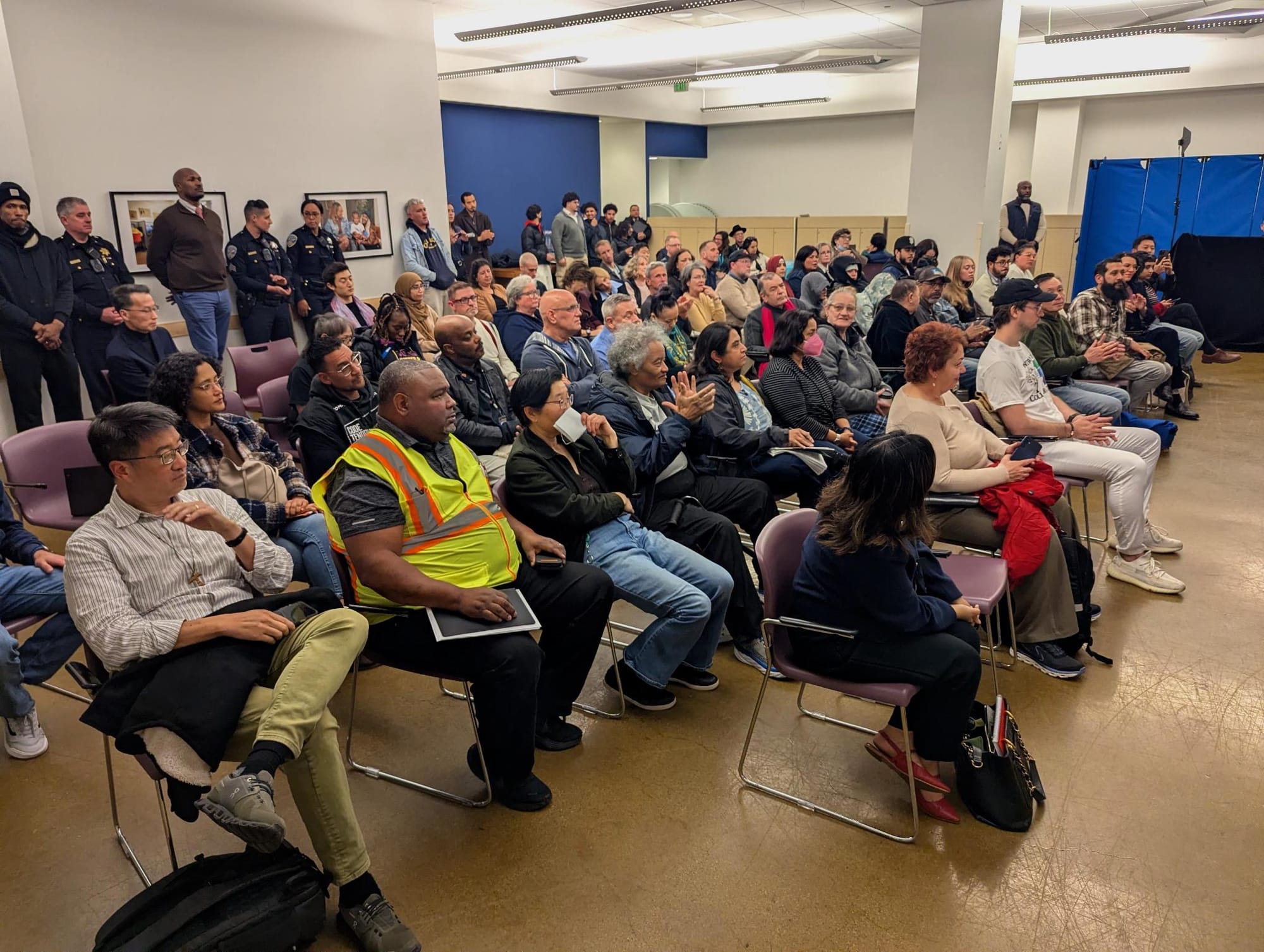
After the meeting, I spoke with four attendees for their thoughts about the event, the officials’ statements, and public safety in the Tenderloin.
Hakim, born and raised in the neighborhood, said the meeting had gone well. He appreciated that the police department has stepped up local foot patrols, which have “made me feel a lot safer in certain areas, specifically on Turk Street, especially when the kids are out.” He also said that a greater officer presence would only go so far; certain drug hotspots are resilient because they generate significant revenue for dealers. He spoke from experience. He has family members who have struggled to pull themselves out of it.
They’ve told him that work outside the black market earns them less, “so they have to work even harder to make a lot of money now, to even survive. So they need to be able to know that there’s opportunities for them” to get away from the streets, Hakim said.
Sebastian Luke, a writer for Beyond Chron, was heartened by the meeting. Previous responses to street conditions haven’t been enough, he said, and what he heard Thursday night gave him hope that things would change.
“What they’re going to do next is what is important. Because they are not going to do the same thing if it’s not working,” Luke said. He liked the idea of the RESET Center, described as an alternative to jail. “They don’t belong in jail, these people. They need help, they need to be put in treatment, housing.”
Resident David Lewis also came away with a good feeling. During his 15 years in his Tenderloin home, crime has always been a problem, but it’s gotten better in recent years. He said he thinks that’s due in part to shifting rhetoric from politicians, and tactics from police, that discourage drug dealers from being here and encourage users to go into rehabilitation programs.
“To see previous administrations simply say, ‘Well you know we can’t really do anything about it, we can’t force them into rehab, we can’t arrest ourselves out of a problem’ — but my take on this whole thing is, well, the hell we can’t,” Lewis said. “If an individual’s lifestyle choices are going to affect my well-being, then I have to intervene. And that’s what I feel that this meeting is talking about, and I appreciate that.”
Another attendee, David Elliott Lewis, wasn’t entirely pleased with the night. (This is a different person with the same first and last names, who co-chairs the neighborhood group Tenderloin People’s Congress and occasionally writes for the TL Voice).
He disliked that questions had to be submitted prior to the event, and members of the public weren’t allowed to pose questions during it.
“There were a bunch of softball questions asked, and my question and my neighbor’s questions weren’t answered,” he said. He would have preferred if all submitted questions were at least made public. He added that he liked that Mahmood had asked the officials what they would have done differently last year, “although I did not hear good answers to that,” Lewis said.
Lewis’ unanswered question: Is District Attorney Jenkins willing to investigate the reported robberies of the apartments at 50 Golden Gate Ave., from which tenants were displaced? Lewis asked her after the meeting, when attendees could speak directly with officials. She told him she would look into it.
I had also submitted a question that wasn’t answered during the meeting: Why did Mahmood handle questions this way?
Though I don’t know the full answer, one of his legislative aides gave me a partial explanation in an email prior to the event, saying that this “helps us ensure panels can touch on topics of interest to attendees.”

The rally happens at 3 p.m., an hour before a City Hall meeting to discuss proposed funding cuts to the event.

The police chief, district supervisor, and others will field questions from the public. All are welcome.

Have you ever gone looking for a certain grocery item and returned home empty-handed? We want to know about it.

The outage will last until noon on Monday, at latest, PG&E says.