
Hospitality House is continuing the fight to stay in SoMa
On the steps of City Hall, staff and supporters of the organization’s Sixth Street Self-Help Center rallied around finding it a new home nearby, and told stories of its positive impacts.
On the steps of City Hall, staff and supporters of the organization’s Sixth Street Self-Help Center rallied around finding it a new home nearby, and told stories of its positive impacts.

Awards went to residents, businesses, and even pets. Special activities are happening through Sunday.

The city is conducting a needs assessment to help inform programming and budget decisions.

Tenderloin farmers’ market shoppers reflect on the fallout if state legislators defund Market Match program.


Update (7/3/26): This story concerns Market Match, a state program that helps shoppers pay for produce at farmers’ markets throughout California — including the Heart of the City market, at San Francisco’s Civic Center. During this budget season’s negotiations, Gov. Gavin Newsom proposed defunding Market Match. The program’s advocates pushed back, and they have secured some funding, enabling Market Match to continue operating for now. San Francisco news outlet Gazetteer wrote on this, and you should read their story to get the fuller picture.
How bad would it be if the Market Match program went away? People in the Tenderloin will tell you that it could take food off their plates.
The program, founded in 2009, enables Californian shoppers at farmers’ markets to buy more produce than they could get through only CalFresh, the state’s deployment of the federal program formerly called food stamps. And Market Match is popular at Heart of the City, a bi-weekly farmers’ market at San Francisco’s Civic Center. In fact, that market is “the largest EBT Market Match user in California by far,” said Steve Pulliam, Heart of the City’s executive director, referring to the electronic-benefits transfer cards that people use to spend money provided by the government.
Market Match is also under threat. Gov. Gavin Newsom’s proposed state budget removes its funding, which would kill the program by early 2027.
In San Francisco, where it is a challenge for lower-income people to live and get by, the elimination of Market Match would have major consequences for people like Richard Kylie, a former Tenderloin resident now based in the nearby Mission District. Kylie lives in subsidized city housing and regularly shops at the Heart of the City market.
“I probably would just eat fewer things,” Kylie said.
Helena also uses Market Match, and echoed Kylie. She’s been coming to San Francisco farmers’ markets for 12 years, and said that if the program were substantially reduced or cut, she would be forced to eat less.
Users can access the program at many participating farmers’ markets, which means that losing it would leave shoppers like Helena with more “limited options,” she said.
“I don’t even remember where [else] to go to get vegetables in this neighborhood. It’s just convenience stores,” Kylie said.
Market Match has “allowed me to have fruits and vegetables all through the month,” he added. The program helps him eat well and lead a healthy lifestyle.
He’s not the only one. Seymore, a 26-year-old native San Franciscan, said the Heart of the City market is essential for his “rehabilitation.”
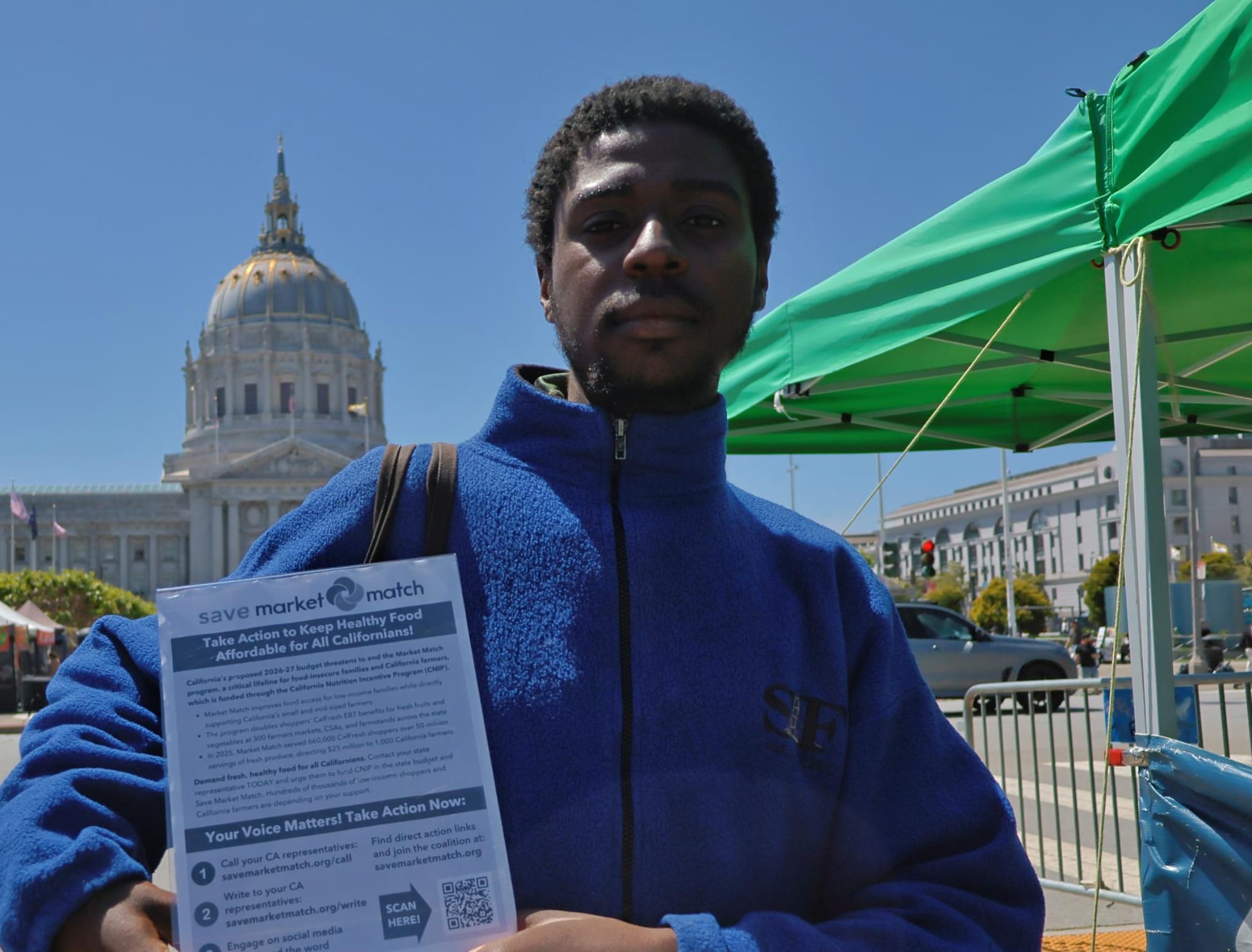
“Now that I’ve grown, I have sensitivities that require me to be very healthy,” Seymore said. He grew up with parents addicted to drugs and went through the foster care system. His foster parents often fed him fast food, which caused long-term health effects “that have kind of crippled me in my adult age,” he said. Seymore buys kale and other vegetables that he needs to care for himself.
These days, Seymore is largely on his own; he doesn’t have a connection with family, he said. That can feel like a struggle — one that is alleviated by the communal nature of the market.
The Heart of the City “gives me a stronger place to spend time … that is positive,” Seymore said. He’s advocated for continued Market Match funding in the past in front of lawmakers, alongside Pulliam.
The California Nutrition Incentive Program (CNIP) funds Market Match. “Since 2015, CNIP has helped 4.2 million shoppers purchase over $130 million in fresh fruits and vegetables — more than a quarter-billion servings,” according to the website for the Save Market Match coalition. The coalition is comprised of organizations, businesses, and individuals committed to Market Match’s survival, for the furtherance of a sustainable, nutritious food economy in San Francisco. Despite the program’s clear benefits for Californians, its advocates must seek renewed funding every few years. The coalition is collecting signatures in support of Market Match, and urging people to contact their lawmakers to restore its funding in the state budget.
Recently, residents of the Tenderloin and food justice advocates went to Sacramento to promote Market Match with state lawmakers. Go here, for that story by the TL Voice:
 Noah Arroyo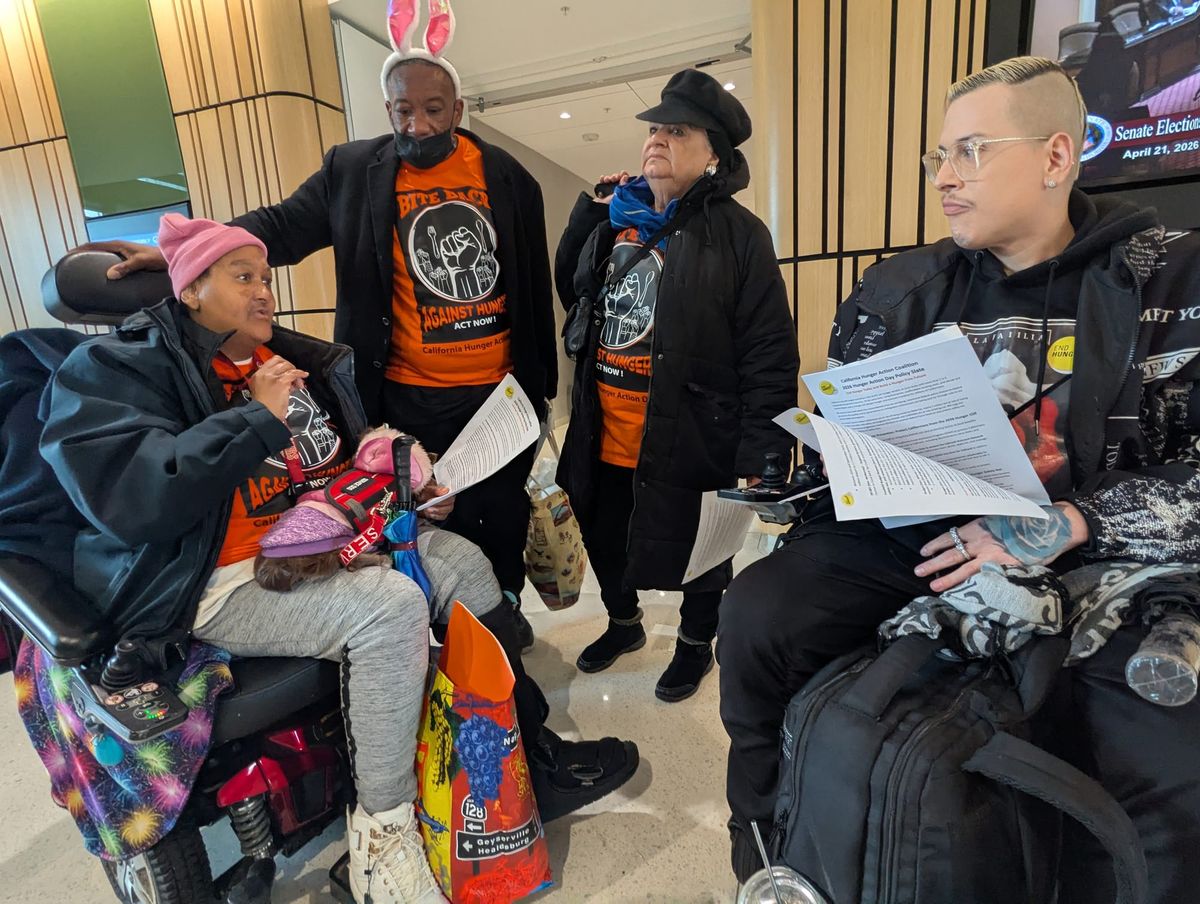
Pulliam, of Heart of the City, who once promoted Market Match in Tenderloin SROs, observed that “there’s so much of a need here in this community. There’s no grocery stores.”
Ken Phan, a farmer who’s sold herbs and greens at Heart of the City for 16 years, said Market Match helps “low-income residents here buy all these fruit and vegetables from us.” But he also sees it as “kind of like a Band-Aid” on larger problems, like the gap between people’s incomes and what they need to afford living in a city.
Market Match has been available to Heart of the City shoppers since 2015, Pulliam said, and he anticipates the funding will be renewed. That’s due, in part, to what he’s hearing from the people who run other farmers’ markets in California, he said. They tell him that their conversations with their own elected politicians have a generally positive tenor. And if the program were to die now, after more than a decade in operation, it would be a very drastic change — and hopefully that means it’s unlikely, he said.
“It’s sort of an easy sell to some of the legislators,” Pulliam said, because it directly benefits shoppers and farmers.
If you want to become part of the coalition supporting and trying to preserve Market Match, go to savemarketmatch.org.

On the steps of City Hall, staff and supporters of the organization’s Sixth Street Self-Help Center rallied around finding it a new home nearby, and told stories of its positive impacts.

Awards went to residents, businesses, and even pets. Special activities are happening through Sunday.

The city is conducting a needs assessment to help inform programming and budget decisions.

The popular program pays musicians to play for the public, including in the Tenderloin. Interested artists can apply until Oct. 1.

Stay tapped into the Tenderloin: Our email newsletter sends every article to your inbox. Unsubscribe anytime.