
Hospitality House is continuing the fight to stay in SoMa
On the steps of City Hall, staff and supporters of the organization’s Sixth Street Self-Help Center rallied around finding it a new home nearby, and told stories of its positive impacts.
On the steps of City Hall, staff and supporters of the organization’s Sixth Street Self-Help Center rallied around finding it a new home nearby, and told stories of its positive impacts.

Awards went to residents, businesses, and even pets. Special activities are happening through Sunday.

The city is conducting a needs assessment to help inform programming and budget decisions.

Funding for a food access program that supports residents and farmers alike is under threat. Advocates are fighting to keep it.


Update (7/3/26): This story concerns the fight to secure funding for Market Match, a state program that helps shoppers pay for produce at farmers’ markets throughout California — including the Heart of the City market, at San Francisco’s Civic Center. During this budget season’s negotiations, Gov. Gavin Newsom proposed defunding Market Match. The program’s advocates pushed back, and they have secured some funding, enabling Market Match to continue operating for now. San Francisco news outlet Gazetteer wrote on this, and you should read their story to get the fuller picture.
Dawn was just spilling onto Turk Street as dozens of Tenderloin advocates climbed into a double-decker bus headed to Sacramento. They were groggy but, not to worry, their task this cloudy April morning was something they’d done before.
They would spend the day pressing state lawmakers to preserve a food-access program that is essential to the neighborhood’s farmers’ market.
“We did it last time, and we’re gonna succeed again this time,” said Lisa Cook, president of the Food Justice League of San Francisco, a Tenderloin-based group that works to put healthy food options within reach for residents. “We all have a voice. And that’s what they need to hear, is our struggles, our stories.”
You see, they had piled into buses in 2024 too. At the time, Gov. Gavin Newsom was proposing a statewide budget that removed funding from the Market Match program, setting it up to die. At farmers’ markets throughout California, shoppers can use Market Match to extend the buying power of their government-issued EBT cards. The program matches their EBT expenditures on produce dollar-for-dollar, up to limits that vary by location. Tenderloin locals went to the state Capitol and pushed hard on politicians to give the program its money — and they prevailed.
This year, Newsom is again proposing to zap the funding. If that happens then Market Match will run out of money in early 2027. So, for Cook and others, it was time to hit the road once more and ask officials to amend the state budget as it winds its way through the Legislature toward approval.
“We’re trying to plant the seed, you understand? Before they get into that mode of voting,” said Tyree Leslie, a local arts aficionado and hype-man. Hopefully, he said, “they hear from enough of us saying the same thing: Fund food.”
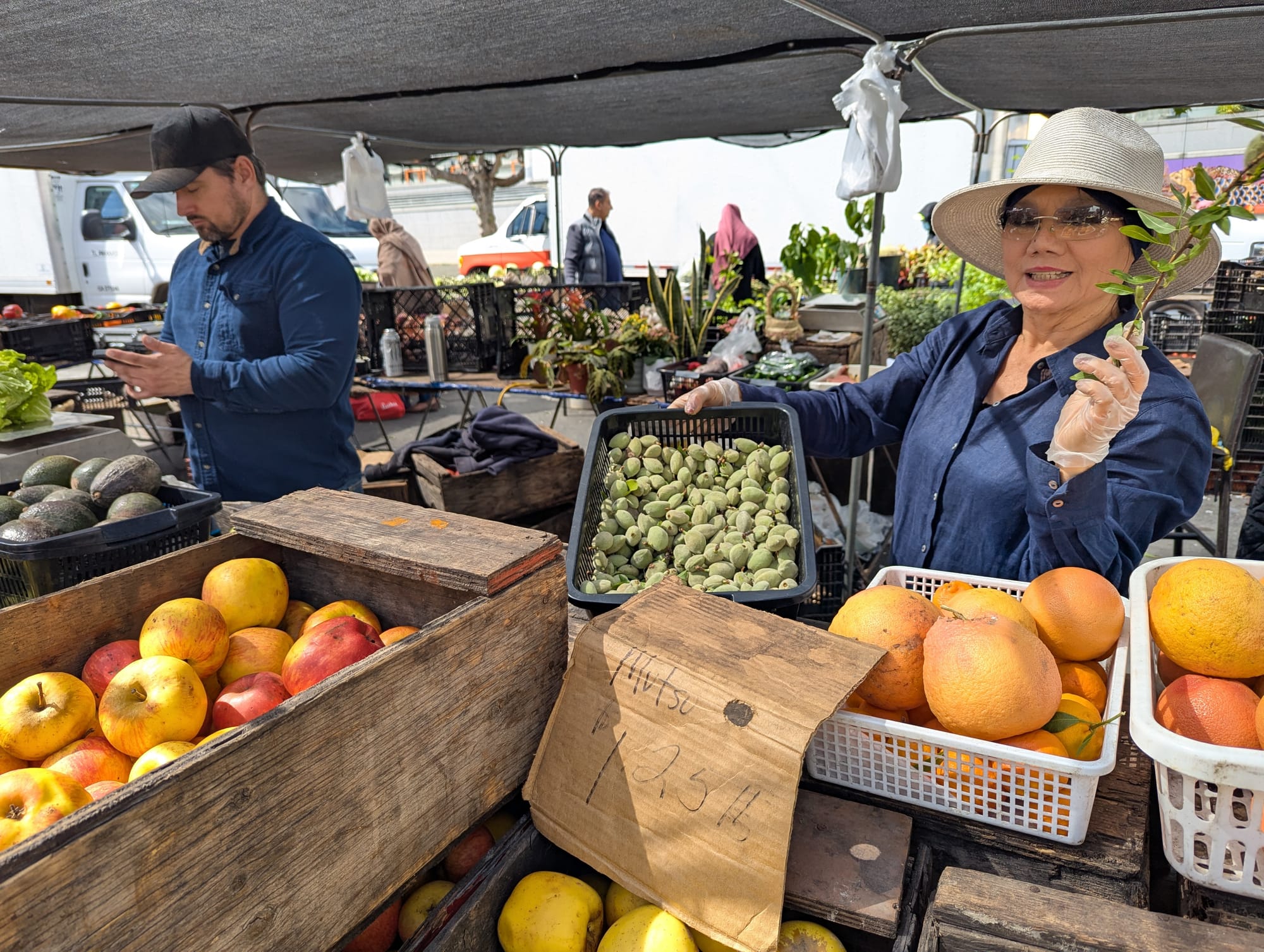
The Heart of the City Farmers’ Market at Civic Center has so much low-income clientele that it is California’s biggest recipient of Market Match funding, said Steve Pulliam, the market’s executive director.
At this market, a shopper can get up to $30 matched per month through the program. That can make all the difference for someone struggling to get by.
Maybe you’ve visited the stalls, some morning, and noticed the long line of people winding down Fulton Street? They were queued to get the vouchers that allow them to spend their Market Match money.
And that line of people is important to the viability of the market, said Curtis Bradford, community organizer at the Tenderloin Neighborhood Development Corporation and one of the people who led the trip to Sacramento.
“Our farmers’ market runs on a tight budget,” Bradford said. He and others who lobbied the state officials are worried that Heart of the City might not be able to continue operating if this program stopped injecting money into it.
When asked if Heart of the City would die without Market Match, Pulliam said, “I would hope that we would be able to survive. But the impact would be ... very detrimental.” In 2025, about $2.98 million in Market Match benefits passed through the market, ultimately landing in farmers’ pockets, along with $2.8 million through EBT.
Pulliam also said the following scenario sounded “realistic”:
Without Market Match, that line might be shorter. Customers would spend less. At day’s end, farmers might have to dump unsold produce. They might start calculating whether it was still worth the time and the gasoline to get here twice a week.
The loss of the program would layer with cuts from the federal government, “where people are going to start losing their benefits and getting benefit reductions,” Pulliam said. “It’s a very tenuous, a shaky time to be thinking about ... people’s ability to put food on their tables.”
The city’s Board of Supervisors has described Market Match as critical. San Francisco “has experienced a number of supermarket closures in recent years, contributing to growing food access challenges,” the supervisors said in March. So they passed a resolution — a statement of opinion, without the force of law — urging Gov. Newsom and the California Legislature to preserve and expand Market Match. Mayor Daniel Lurie did not sign the resolution.
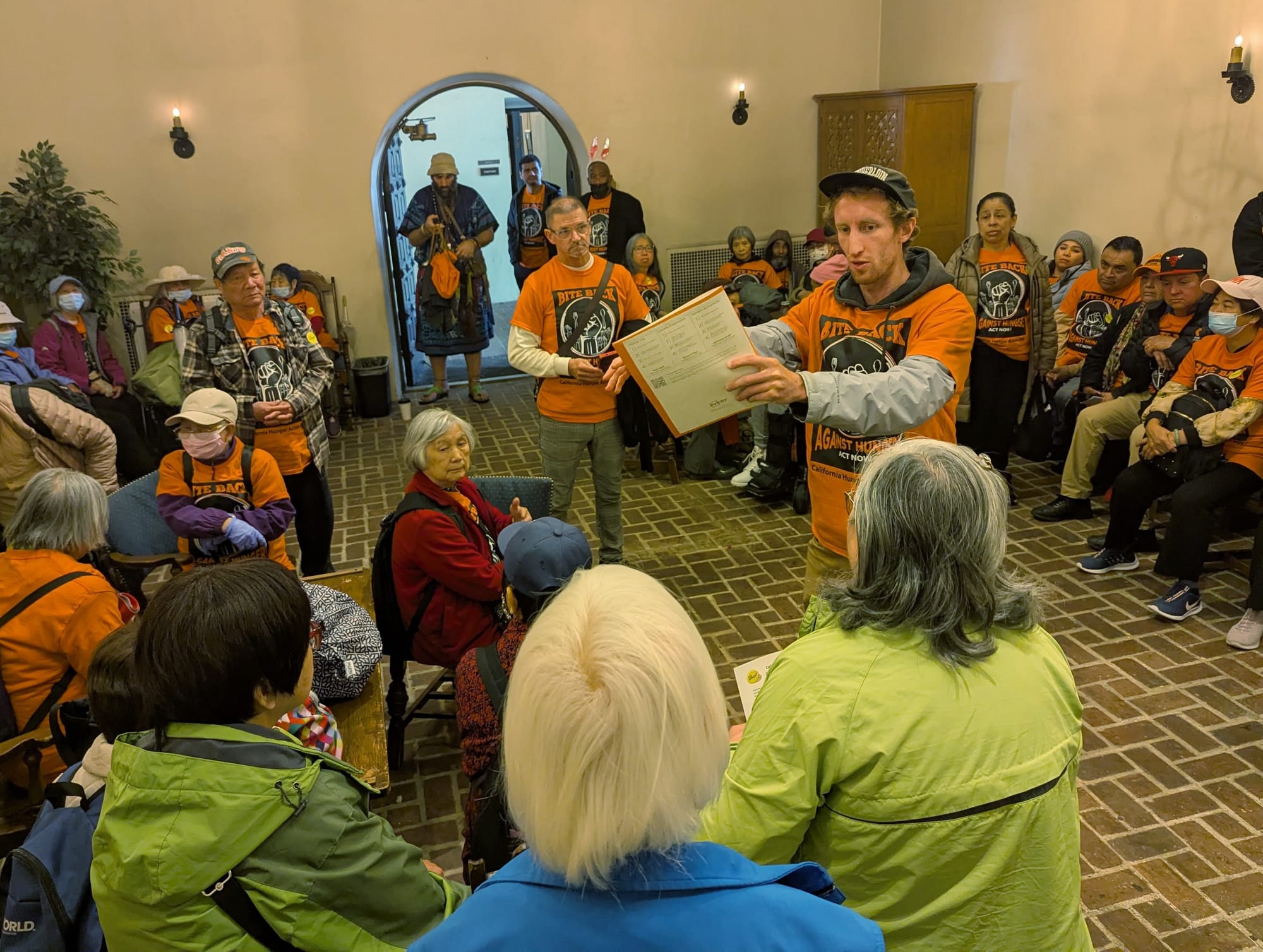
At the state Capitol, the Tenderloin’s Food Justice League was impressing upon lawmakers how indispensable Heart of the City and Market Match are. The league had a crew of about 70, including members, their families, and others from the community. The Tenderloin Neighborhood Development Corporation and Chinatown Community Development Center had rented the buses to get them there. It was all part of Hunger Action Day, organized by the California Hunger Action Coalition. People from around the state showed up to lobby for a variety of programs and policies related to increasing food access.
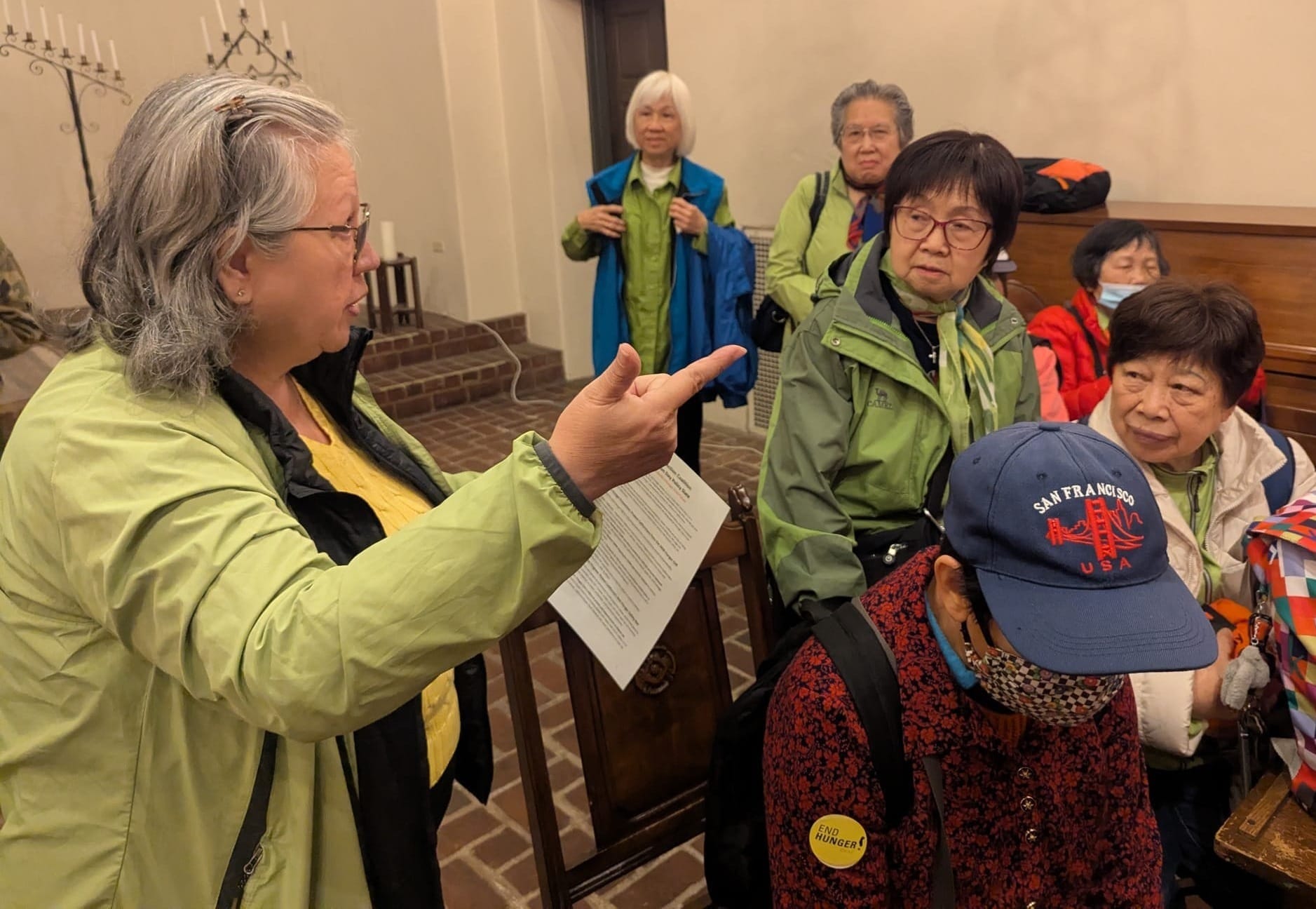
Scrambling through beige hallways and cramming into tiny, stuffy office waiting rooms, groups of league members made their case, bending the ears of any policymaker or staffer they could find.
“We need everyone to have a positive attitude!” said Ray Orfiano, while his cadre roamed the corridors.
I shadowed Orfiano’s contingent as they sought out two Democratic assemblymembers: Matt Haney, who represents the eastern half of San Francisco, and Damon Connolly, who represents Marin County and part of Sonoma. Both have expressed support for Market Match. Neither politician was present in their offices, but their staff received the group and listened.
The Tenderloin is generally known as a food desert. Produce and other healthy eats can be hard to find, especially at prices residents can afford. The neighborhood’s median annual household income is $46,255, about one-third of the citywide median, $140,970, according to 2024 U.S. Census data.
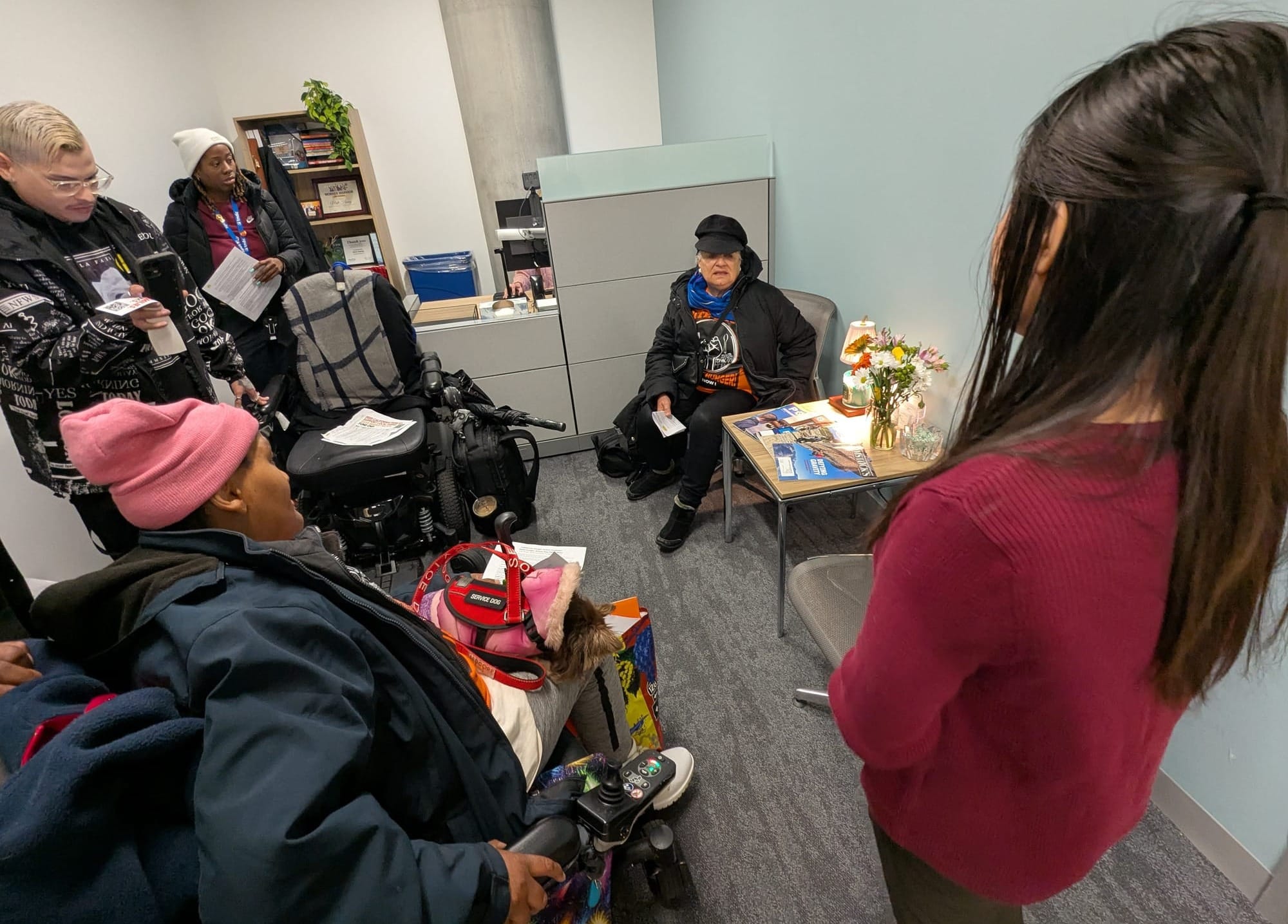
Orfiano said he suspects that the politicians willing to defund the program can’t relate to low-income people’s struggles.
“They have a lot of money and they can buy whatever food they want,” Orfiano said. That’s unlike many Tenderloin residents. “There are stores with organic foods, but it’s not food we can afford.”
At Connolly’s office, the team explained that, to many people here, the farmers’ market is a cherished oasis.
“The farmers’ market is basically the only way to get fresh vegetables, fresh fruit,” said Desira Brown, community organizer at the Tenderloin Neighborhood Development Corporation. If the market were less usable or disappeared, “it will be a very hard thing on elderly folks, people with mobility issues, to just get to the nearest grocery store — because there isn’t a nearest grocery store.”
Sure, there are programs like Meals on Wheels that deliver food to older adults. But Joy Abounds, a vegetarian and senior who lives in the TL, told Connolly’s staffer that these programs have drawbacks.
“A lot of times the food is lousy. The vegetables taste like they’re out of a can. They’re not fresh,” said Abounds, who added that she tries to avoid preservatives and cooks her own food. She prefers the produce options and quality found at the market.
If the market were less of a resource, TL shoppers would likely resort to corner stores. Their prices are higher, their produce options sparse.
David Grace, who lives at the Senator Hotel in the Tenderloin, underlined Market Match’s knock-on benefits to the staffer. Every $1 spent through it stimulates up to $3 in economic activity, including by helping farmers expand operations and staffing, according to a 2021 analysis co-authored by San Francisco think tank SPUR. And Market Match indirectly helps customers avoid health care expenses. “The people get good food, and they don’t need doctors as often,” Grace said. He questioned those who’d oppose the program over its direct costs: “How can a fiscal conservative be throwing away money?”
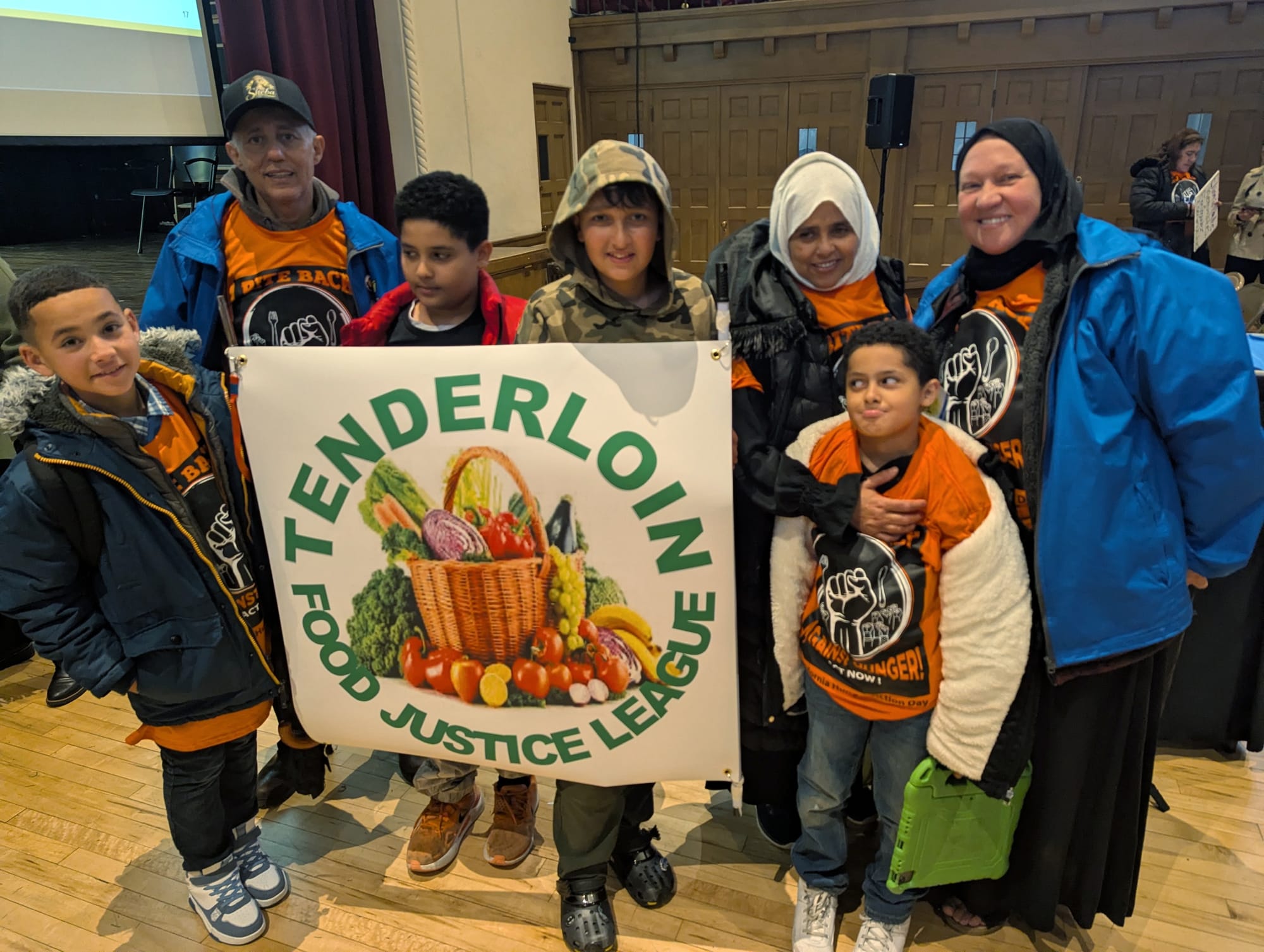
Many politicians and organizations already support Market Match, but that isn’t enough to ensure its survival.
Assemblymember Connolly had written a public letter not only advocating to keep Market Match funding, but to grow it and make it permanent. This would insulate Market Match from budget season wranglings, make it available at all farmers’ markets statewide, and slightly increase the matched amounts for customers. The letter is backed by hundreds of organizations, governments, and politicians, including Assemblymember Haney, his staff told me. (Staff members for State Senator Scott Wiener, who represents San Francisco, did not respond to a request for his position on Market Match by press time.)
But there are good reasons to lobby apparent allies, said John McCormick, resident services coordinator at Chinatown Community Development Center and one of the day’s chief conductors. The goal is to “be more fresh on the brain” than other groups lobbying for their own causes at the same time, McCormick said.
“The budget is so complex and there is so much going on,” McCormick said. “Maybe it comes down to, ‘Do we want to fund Market Match, or fund the arts?’”
After confronting politicos, the gang grabbed a meal and hustled to make it to the bus, which would depart on the hour, sharp. I took a bit too long, and got the stink eye from Jalal Alabsi. “We worried,” he said, dourly. Then he flashed me his toothy smile. All was forgiven.
On the ride back, my brain was stuck on something Leslie — the arts enthusiast I mentioned early in this story — had said that day about the issues that brought him there. I’ve thought about it many times since. He talked about how the federal government is squeezing low-income people, pursuing expensive wars while slashing benefits, including nutrition assistance.
It’s hard to believe that there’s no room in California’s multi-hundred-billion-dollar budget to fill the gaps left for its poorest residents. According to one think tank, the state could make changes to bring in more revenue instead of cutting sorely needed programs.
“So basically, tax the rich, tax the billionaires,” Leslie said. “These are some alternatives to where you can get this money from. So don’t act like it’s not there.”
Editor’s note (5/13/26): An earlier version of this story called the group the Tenderloin Food Justice League. We’ve updated the story to reflect the official name, Food Justice League of San Francisco. Community members may know them by their former name, Tenderloin Food Policy Council.

On the steps of City Hall, staff and supporters of the organization’s Sixth Street Self-Help Center rallied around finding it a new home nearby, and told stories of its positive impacts.

Awards went to residents, businesses, and even pets. Special activities are happening through Sunday.

The city is conducting a needs assessment to help inform programming and budget decisions.

The popular program pays musicians to play for the public, including in the Tenderloin. Interested artists can apply until Oct. 1.

Stay tapped into the Tenderloin: Our email newsletter sends every article to your inbox. Unsubscribe anytime.