
Tenderloin family summit lets residents weigh in on future spending
The city is conducting a needs assessment to help inform programming and budget decisions.
The city is conducting a needs assessment to help inform programming and budget decisions.

The popular program pays musicians to play for the public, including in the Tenderloin. Interested artists can apply until Oct. 1.

Issue 4 of the TL Voice print edition is being distributed now.


All day at City Hall, people queued up for their last chance to urge lawmakers to preserve the programs that had helped them or others.

Hundreds of San Francisco residents and nonprofit staff filled City Hall on Wednesday, asking legislators to restore funding to services slated for cuts in the next fiscal year, which begins in July.
Among them were Tenderloin residents, workers, and activists who demanded the full restoration of $3.8 million in proposed cuts to neighborhood programs and services — part of city officials’ strategy to close a projected $642 million two-year deficit. The cuts would impact more than 5,600 residents, according to the People’s Budget Coalition, a group that has been tracking the city’s budget process.
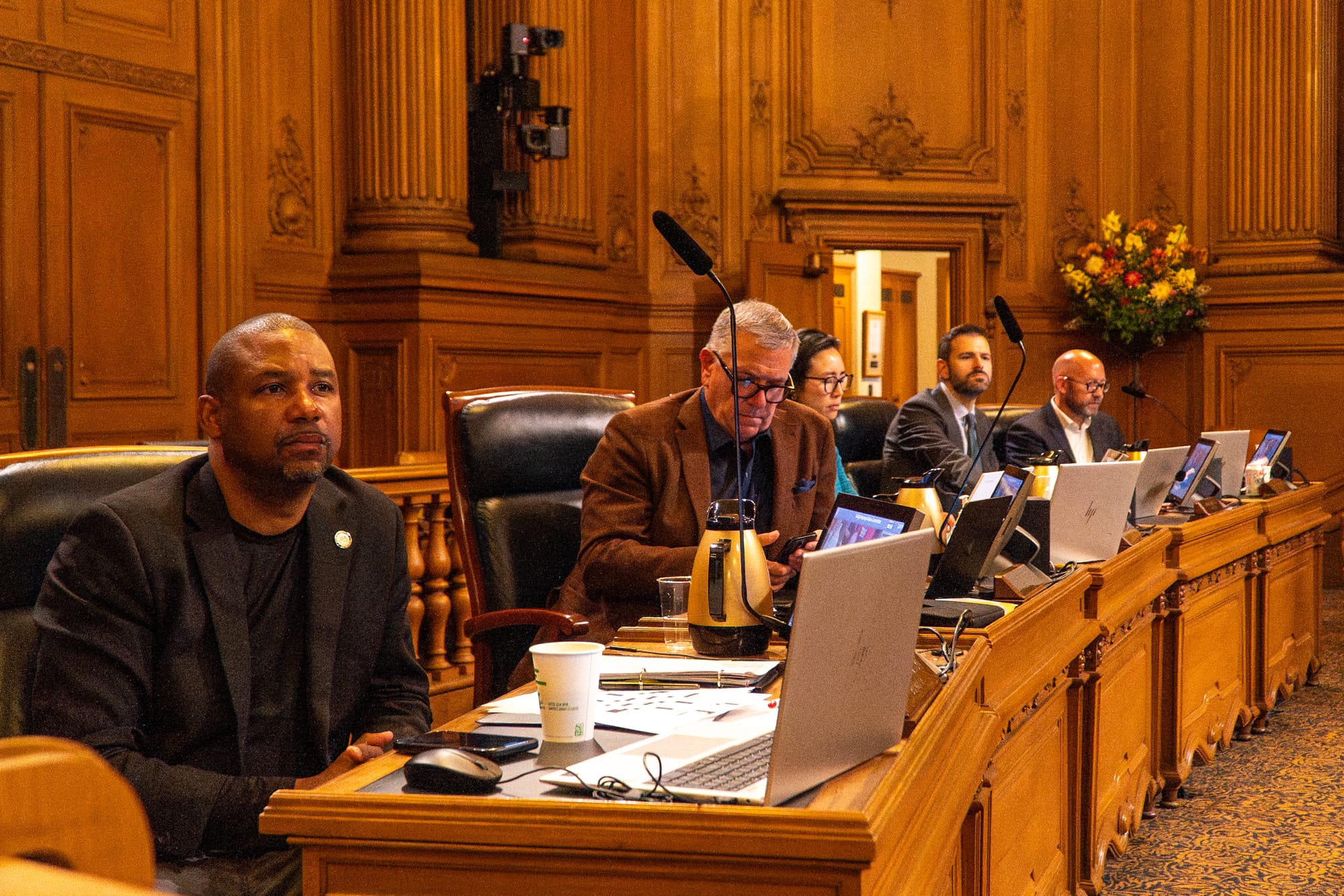
The throngs were there for Public Comment Day, an all-day hearing wherein attendees each got one minute to tell the Board of Supervisors’ Budget and Appropriations Committee what they thought of the budget on the cusp of its finalization.
“These are vital services that our residents depend on to maintain their lives,” said Curtis Bradford, community organizing manager for the Tenderloin Neighborhood Development Corporation and a resident of the neighborhood.
The Tenderloin Voice has been consistently covering how the city’s proposed budget cuts would affect the Tenderloin community — and how the neighborhood has mobilized against that.
Do you value that work? Just $1 a month, and we’ll know that you’re in this with us.
As the public commenters took their turns at the mic, Bradford was one of several organizers visiting supervisors’ offices to try to persuade their aides against the cuts. He was motivated to organize because, earlier in life, he had received services that helped him escape homelessness and drug addiction.
“I’m fighting to keep the doorways open to recovery and access to services that I utilized,” Bradford said.
In the supervisors’ offices, he argued that the city could balance its budget without cuts to the Tenderloin’s services and that funding existing services would be cheaper than the alternative.
“More expensive solutions like emergency room visits and police interventions — it’s going to cost us more money, and we’re going to get worse results and conditions are going to deteriorate,” he said. “That’s what happens when you cut frontline critical safety-net services.”
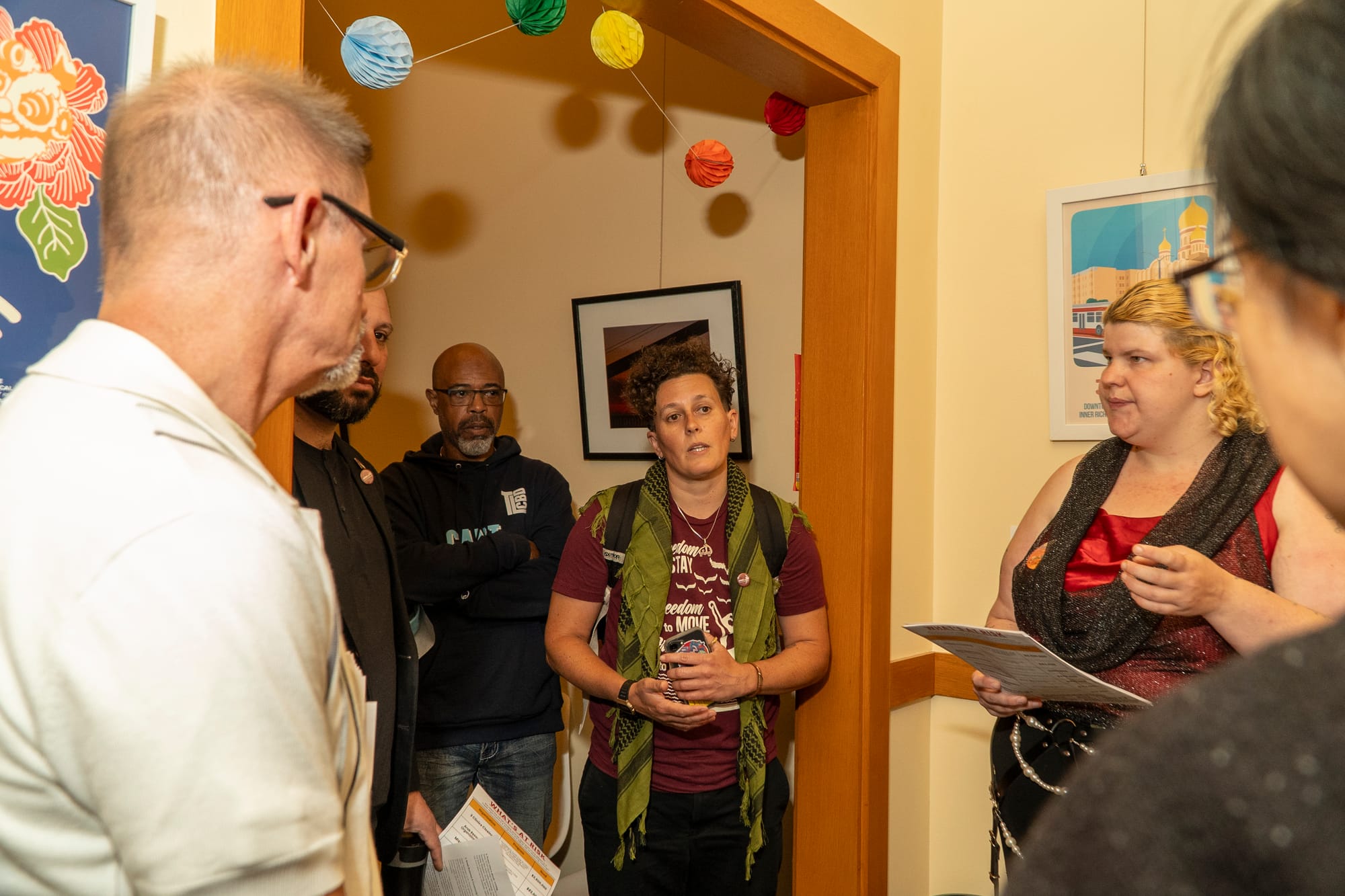
Xander Briere, policy and education co-chair with the HIV Advocacy Network, was another person fighting to protect services that they have used. Briere ran away from home at age 14 to escape their abusive mother.
“A wonderful case manager made sure that I was safe and seen and immediately had contact with my dad,” Briere said. “Within about two months, I was in New Orleans in a safer home, with a family that wanted me there.”
Briere utilized housing services again throughout their early 20s, eventually obtaining enough stability to no longer need that help. Today they live in the Tenderloin.
“I want to advocate for these life-saving safety nets even though I no longer access them, because I know just what they do to protect our communities,” Briere said. They highlighted that three clinics in the city are slated for closure, including the Cole Street Clinic, run by Huckleberry Youth Programs.
The Michael Baxter Clinic, within Larkin Street Youth Services, is among the three. It faces closure in part because of reductions in Medi-Cal and Medicaid funding. Cuts to youth services mean that young people will lose access to food, crisis counseling, and emergency hotel vouchers, said Marnie Regan, Larkin Street’s division director of government relations.
Regan used to live in the Tenderloin and saw permanent improvements first-hand as a result of supportive programs there being funded. She said preserving services in the neighborhood is essential because it’s where there’s the most need.
“It’s the last sort of vestige of housing that people can afford — it’s mostly working people, a lot of immigrants,” Regan said. “The TL for a long time has been used as a sort of containment zone, and we can’t accept that,” Regan said.
For some organizations and the clients they serve, the city’s proposed budget reductions would slice especially deep. The Southeast Asian Development Center is facing approximately $625,000 in cuts.
“What’s at risk is basically all of our adult programs, and that includes definitely our employment services,” said Ratha Chuon, the center’s director of programs. “We are one of the very few that provide services to monolingual clients in the city” who do not speak English, she said.
During the hearing, Chuon drew on her experiences as a refugee and said many members of the Southeast Asian community share trauma from displacement and migration. Chuon said the center’s programs provide stability, trust, and access to life-saving support.
“To remove these services is to add so much harm to our community that’s already struggling to survive in San Francisco,” Chuon said.
The Arab Resource and Organizing Center is facing an $83,000 cut that will completely eliminate funding to help immigrants find and access services. Mohamed Shehk, the center’s organizing director, said the Tenderloin has the highest concentration of Arabs in the city, particularly refugees.
AROC is San Francisco’s only organization that provides language services to help Arabs with their immigration cases, Shehk said.
“We would need to continue doing this work without any funding from the city, and what it would mean is that we would likely have to scale back,” Shehk said.
The day of final budget deliberations is June 25. It begins at 10 a.m., in City Hall’s Room 250, and it can last all day and late into the night, which has earned it the name “add-back night.” City supervisors go through San Francisco’s budget line-by-line and make adjustments, moving funds around. It’s the last chance for experts and advocates — more so than the general public — to make their case to legislative staff to put money back into threatened programs. If you show up, find the seasoned budget organizers (like folks from the People’s Budget Coalition) and take your cues from them on how to most effectively lobby legislators on this day.
This journalism was made possible with funding from the San Francisco Foundation.

The city is conducting a needs assessment to help inform programming and budget decisions.

The popular program pays musicians to play for the public, including in the Tenderloin. Interested artists can apply until Oct. 1.

Issue 4 of the TL Voice print edition is being distributed now.

The business is a blend of cultures, just like the family behind it.
Stay tapped into the Tenderloin: Our email newsletter sends every article to your inbox. Unsubscribe anytime.